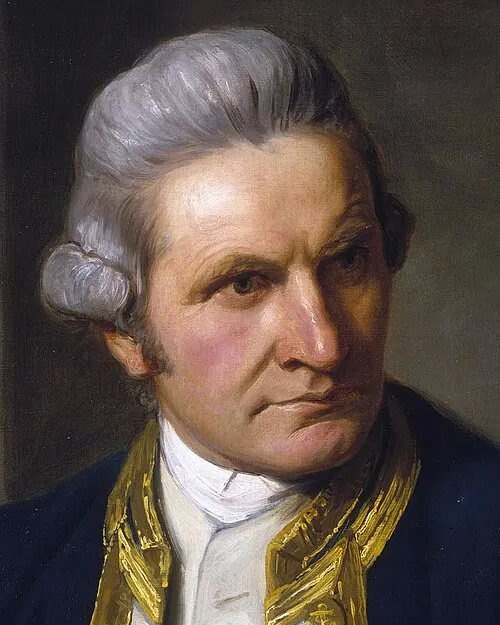
James Cook, painted after his second Pacific voyage. Nathaniel Dance-Holland · Public domain.
James Cook was a British naval officer and mapmaker whose three Pacific voyages reshaped European knowledge of the ocean in the eighteenth century. He searched for a southern continent and a northern sea passage, carrying astronomers, artists and naturalists. But the Pacific was already a world of skilled navigators and established societies. Following his ships reveals remarkable seamanship, dependence on local knowledge, and encounters that brought exchange, violence and lasting change.
Historical dates and route context
The story reuses the three Pacific voyages in Explorations. Selected dated stages and offshore corridors are schematic reconstructions, not daily log positions. Repeated positions represent documented stays and repairs; most minor landfalls are omitted. Journal and civil dates can differ by a day. The two-ship expeditions are represented by a vessel-class marker following the lead ship’s selected route; detached ships do not have independently reconstructed tracks. After Cook’s death, the third track follows the surviving expedition under Clerke and Gore. Modern borders do not imply historic sovereignty or consent to British claims.
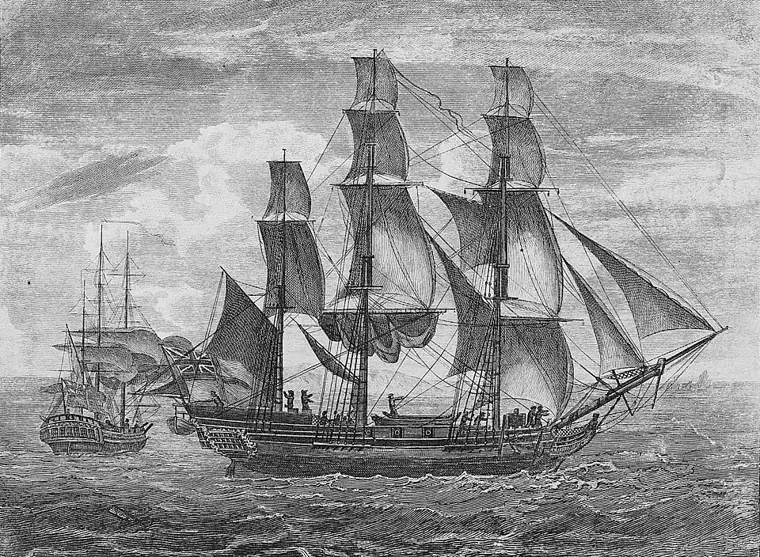
A later historical illustration of Endeavour and Cook setting out. Lane (historical illustrator); Wellcome Collection · CC BY 4.0.
Endeavour leaves Plymouth in August 1768. The small, broad-bottomed vessel once carried coal; now its holds must accommodate food, water and scientific equipment for a long expedition. Joseph Banks and Daniel Solander will collect plants, while artists record what they see. Cook brings years of surveying experience. Ahead lie an Atlantic crossing and a passage around South America, on the way to Tahiti.
Historical dates and route context
The story reuses the three Pacific voyages in Explorations. Selected dated stages and offshore corridors are schematic reconstructions, not daily log positions. Repeated positions represent documented stays and repairs; most minor landfalls are omitted. Journal and civil dates can differ by a day. The two-ship expeditions are represented by a vessel-class marker following the lead ship’s selected route; detached ships do not have independently reconstructed tracks. After Cook’s death, the third track follows the surviving expedition under Clerke and Gore. Modern borders do not imply historic sovereignty or consent to British claims.
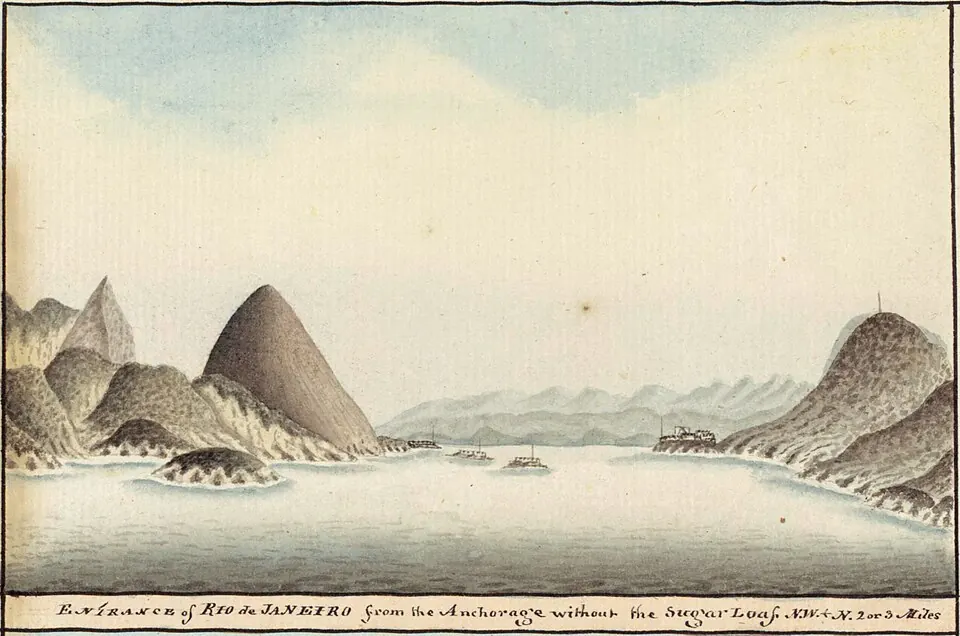
Rio de Janeiro harbour in a later eighteenth-century view by George Raper; geographical context. George Raper · Public domain.
At Rio de Janeiro, Portuguese officials restrict the visitors’ movements. Repairs and fresh provisions take time, and Banks finds his collecting ambitions frustrated. The ship leaves in December, heading south towards colder seas. Beyond the tip of South America lies the Pacific, but first the crew must negotiate the waters around Cape Horn.
Historical dates and route context
The story reuses the three Pacific voyages in Explorations. Selected dated stages and offshore corridors are schematic reconstructions, not daily log positions. Repeated positions represent documented stays and repairs; most minor landfalls are omitted. Journal and civil dates can differ by a day. The two-ship expeditions are represented by a vessel-class marker following the lead ship’s selected route; detached ships do not have independently reconstructed tracks. After Cook’s death, the third track follows the surviving expedition under Clerke and Gore. Modern borders do not imply historic sovereignty or consent to British claims.
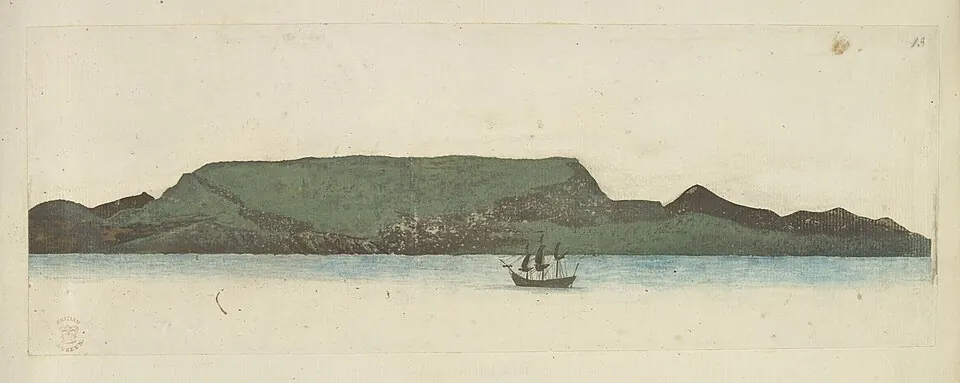
Endeavour off Tierra del Fuego during the first voyage. Alexander Buchan · Public domain.
Once past Cape Horn, Endeavour faces thousands of miles of open Pacific. Watches, sail handling and repeated observations give shape to days when land is out of sight. The destination is Tahiti, chosen for an observation that must happen on a particular day. Cook reaches Matavai Bay in April, leaving time to build an observatory before Venus crosses the Sun in June.
Historical dates and route context
The story reuses the three Pacific voyages in Explorations. Selected dated stages and offshore corridors are schematic reconstructions, not daily log positions. Repeated positions represent documented stays and repairs; most minor landfalls are omitted. Journal and civil dates can differ by a day. The two-ship expeditions are represented by a vessel-class marker following the lead ship’s selected route; detached ships do not have independently reconstructed tracks. After Cook’s death, the third track follows the surviving expedition under Clerke and Gore. Modern borders do not imply historic sovereignty or consent to British claims.
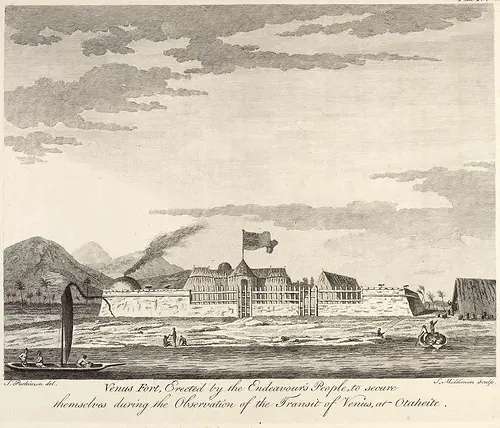
A historical depiction of Fort Venus, the expedition observatory on Tahiti. Charles Praval after H. D. Söring · Public domain.
On 3 June 1769, Cook and astronomer Charles Green watch Venus move across the face of the Sun. Comparing observations made far apart should help calculate the Earth’s distance from it. The measurements are difficult, and observers disagree about the exact moments of contact. The expedition also has secret instructions: after this astronomical mission, search south for a continent and investigate New Zealand.
Historical dates and route context
The story reuses the three Pacific voyages in Explorations. Selected dated stages and offshore corridors are schematic reconstructions, not daily log positions. Repeated positions represent documented stays and repairs; most minor landfalls are omitted. Journal and civil dates can differ by a day. The two-ship expeditions are represented by a vessel-class marker following the lead ship’s selected route; detached ships do not have independently reconstructed tracks. After Cook’s death, the third track follows the surviving expedition under Clerke and Gore. Modern borders do not imply historic sovereignty or consent to British claims.
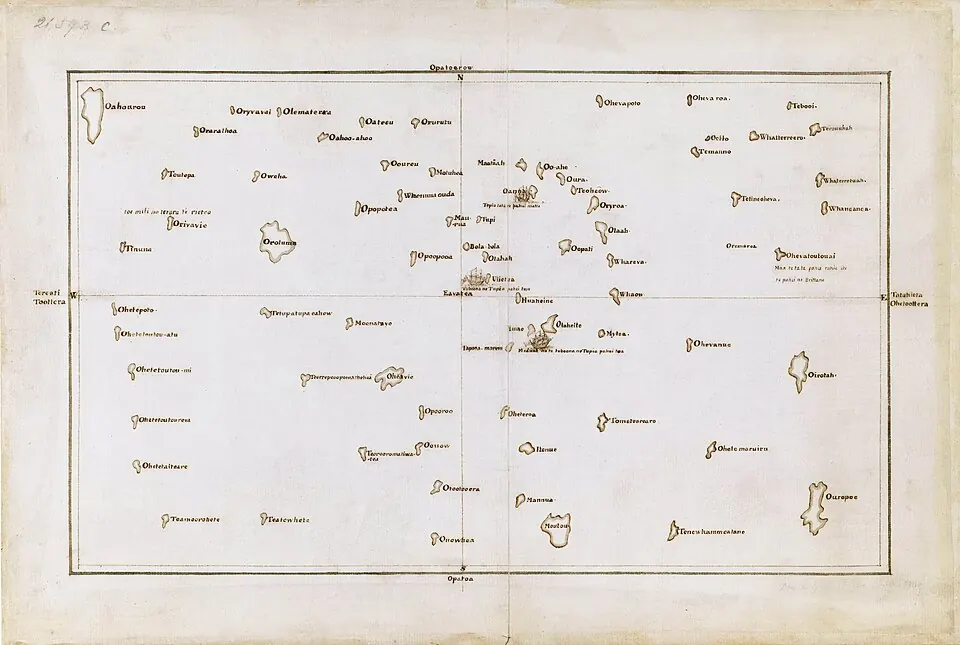
A chart recording Tupaia’s knowledge of Pacific islands. Tupaia; drawn with the Endeavour expedition · Public domain.
When Endeavour leaves Tahiti, Tupaia and the younger Taiata sail with it. Tupaia is a priest, navigator and diplomat from Ra‘iātea. His knowledge connects islands through remembered routes, winds and relationships. He helps create a map naming dozens of islands, revealing an ocean Europeans scarcely understand. Cook’s orders eventually take the ship south and west, towards Aotearoa New Zealand.
Historical dates and route context
The story reuses the three Pacific voyages in Explorations. Selected dated stages and offshore corridors are schematic reconstructions, not daily log positions. Repeated positions represent documented stays and repairs; most minor landfalls are omitted. Journal and civil dates can differ by a day. The two-ship expeditions are represented by a vessel-class marker following the lead ship’s selected route; detached ships do not have independently reconstructed tracks. After Cook’s death, the third track follows the surviving expedition under Clerke and Gore. Modern borders do not imply historic sovereignty or consent to British claims.
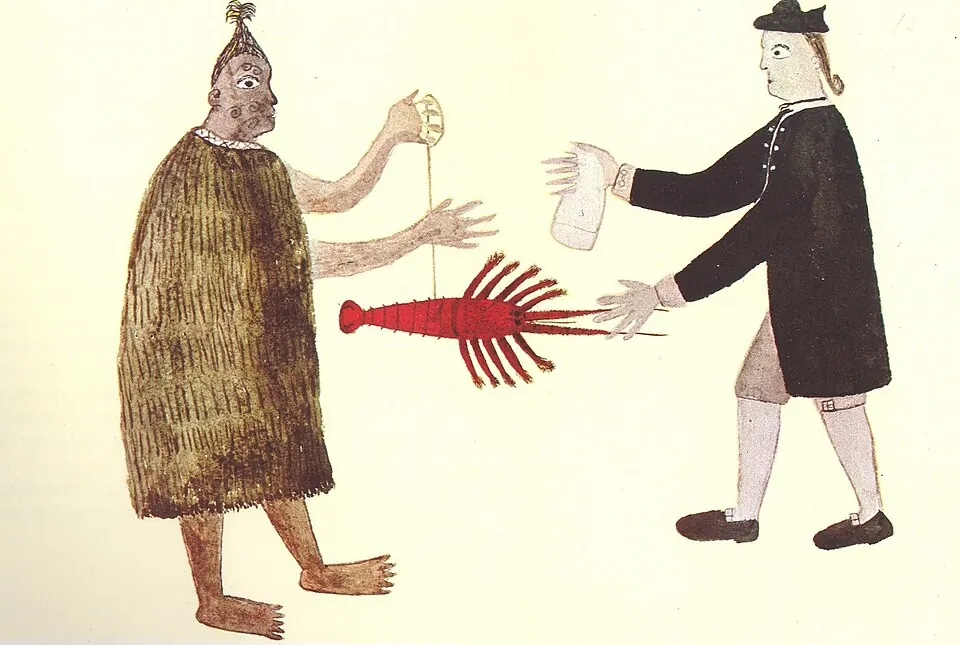
Tupaia’s drawing of a Māori man trading a crayfish for cloth; the other figure is often identified as Joseph Banks, although that identification is disputed. Tupaia · Public domain.
At Tūranganui-a-Kiwa, the first landings turn violent. Men from Endeavour shoot Māori, including Te Maro, and a failed attempt to seize fishermen causes further deaths. Tupaia can speak with Māori in a related language. His explanations and standing help open exchanges and access to supplies as the ship surveys the coast. These are meetings between peoples with their own purposes, not visits to an empty shore.
Historical dates and route context
The story reuses the three Pacific voyages in Explorations. Selected dated stages and offshore corridors are schematic reconstructions, not daily log positions. Repeated positions represent documented stays and repairs; most minor landfalls are omitted. Journal and civil dates can differ by a day. The two-ship expeditions are represented by a vessel-class marker following the lead ship’s selected route; detached ships do not have independently reconstructed tracks. After Cook’s death, the third track follows the surviving expedition under Clerke and Gore. Modern borders do not imply historic sovereignty or consent to British claims.
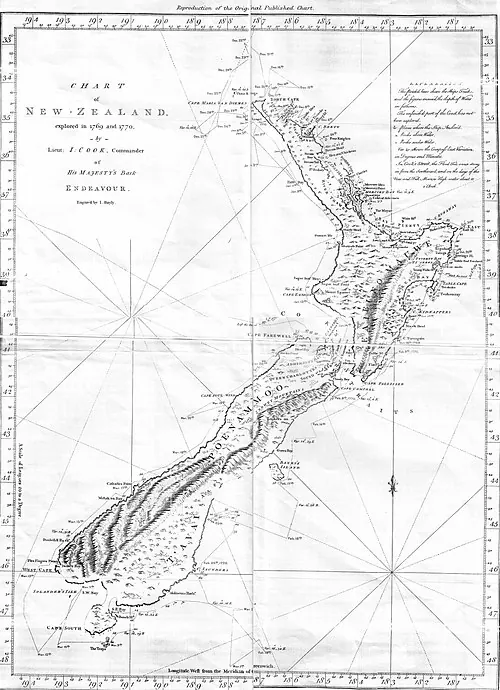
Cook’s chart of New Zealand, recording Endeavour’s coastal surveys. James Cook · Public domain.
After almost six months around New Zealand, Cook has charted much of its coastline and established that it is separate from the imagined great southern continent. Surveying requires patient observation and repeated coastal approaches, supported by food and information obtained locally. Endeavour now leaves the sounds at the north of the South Island. Across the Tasman Sea lies the Australian coast, and ahead, the anchorage Cook will name Botany Bay.
Historical dates and route context
The story reuses the three Pacific voyages in Explorations. Selected dated stages and offshore corridors are schematic reconstructions, not daily log positions. Repeated positions represent documented stays and repairs; most minor landfalls are omitted. Journal and civil dates can differ by a day. The two-ship expeditions are represented by a vessel-class marker following the lead ship’s selected route; detached ships do not have independently reconstructed tracks. After Cook’s death, the third track follows the surviving expedition under Clerke and Gore. Modern borders do not imply historic sovereignty or consent to British claims.
Sydney Parkinson’s depiction of two Gweagal men at Botany Bay. Sydney Parkinson · Public domain.
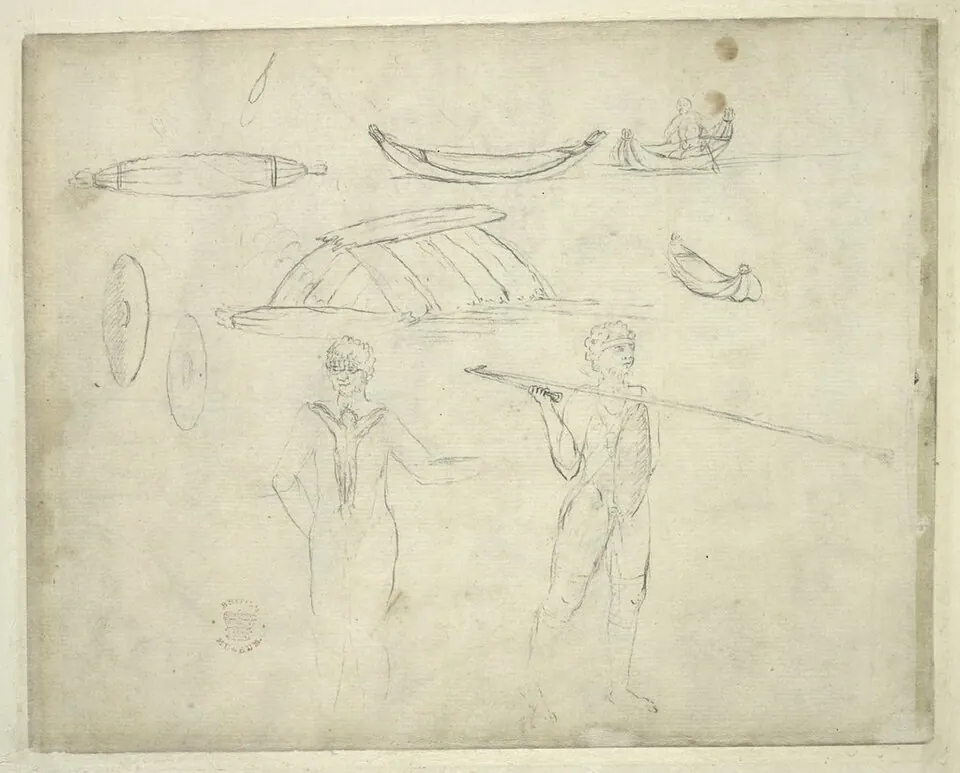
At Kamay, or Botany Bay, two Gweagal men oppose the landing. Cook fires his musket, wounding one. For the next eight days, the visitors collect plants and replenish supplies, while many local people avoid them or reject their gifts. This is an inhabited country with its own laws and relationships. Heading north, Endeavour begins a dangerous coastal survey through waters edged by reefs.
Historical dates and route context
The story reuses the three Pacific voyages in Explorations. Selected dated stages and offshore corridors are schematic reconstructions, not daily log positions. Repeated positions represent documented stays and repairs; most minor landfalls are omitted. Journal and civil dates can differ by a day. The two-ship expeditions are represented by a vessel-class marker following the lead ship’s selected route; detached ships do not have independently reconstructed tracks. After Cook’s death, the third track follows the surviving expedition under Clerke and Gore. Modern borders do not imply historic sovereignty or consent to British claims.
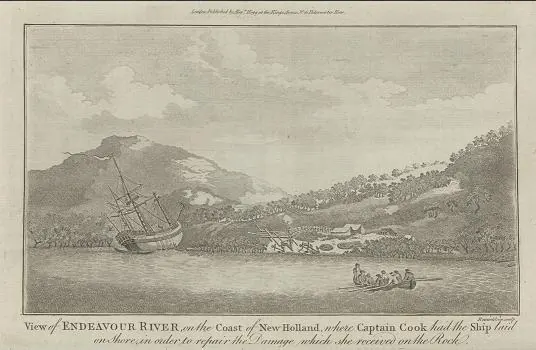
A later engraving of Endeavour being repaired at the Endeavour River. Martin Rennoldson after Sydney Parkinson · Public domain.
Endeavour strikes a reef in June. The crew throws guns and ballast overboard, works the pumps and eventually frees the ship. A sail packed with fibres is hauled beneath the hull to slow the leak. At the Endeavour River, repairs occupy weeks in Guugu Yimithirr country. Only in August can the ship continue north, through Torres Strait and on towards the Dutch port of Batavia.
Historical dates and route context
The story reuses the three Pacific voyages in Explorations. Selected dated stages and offshore corridors are schematic reconstructions, not daily log positions. Repeated positions represent documented stays and repairs; most minor landfalls are omitted. Journal and civil dates can differ by a day. The two-ship expeditions are represented by a vessel-class marker following the lead ship’s selected route; detached ships do not have independently reconstructed tracks. After Cook’s death, the third track follows the surviving expedition under Clerke and Gore. Modern borders do not imply historic sovereignty or consent to British claims.
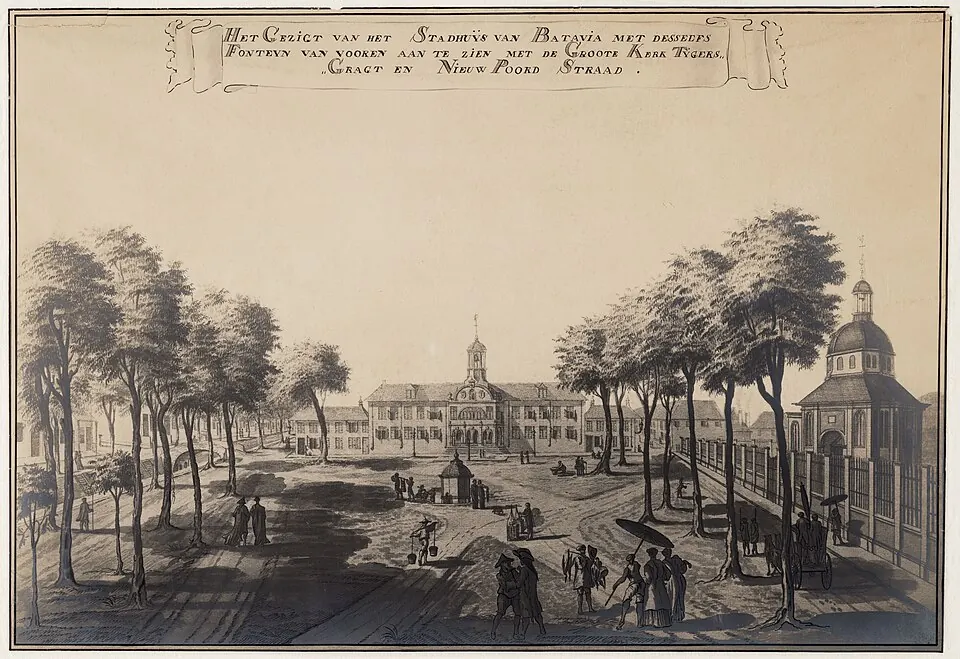
Batavia’s town hall and canals in a contemporary view. Attributed to Johannes Rach · Public domain.
Batavia, now Jakarta, offers the facilities needed to refit Endeavour, but disease devastates the company. Tupaia and Taiata die here; more deaths follow after the ship sails. The losses include artist Sydney Parkinson and naturalist Herman Spöring. The surviving crew carries the charts, drawings and specimens across the Indian Ocean and around southern Africa. In July 1771, Endeavour finally reaches England.
Historical dates and route context
The story reuses the three Pacific voyages in Explorations. Selected dated stages and offshore corridors are schematic reconstructions, not daily log positions. Repeated positions represent documented stays and repairs; most minor landfalls are omitted. Journal and civil dates can differ by a day. The two-ship expeditions are represented by a vessel-class marker following the lead ship’s selected route; detached ships do not have independently reconstructed tracks. After Cook’s death, the third track follows the surviving expedition under Clerke and Gore. Modern borders do not imply historic sovereignty or consent to British claims.
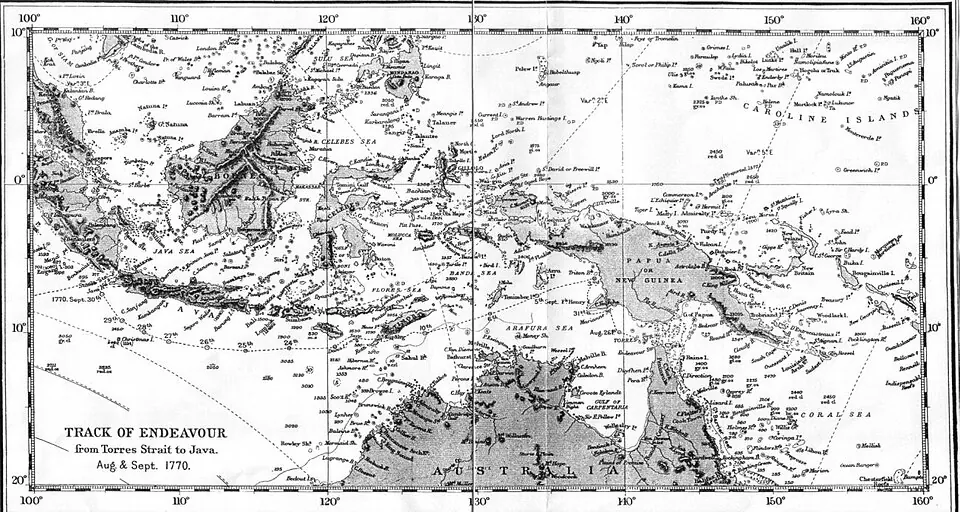
A published chart of Endeavour’s first voyage. James Cook; published in an 1893 edition of his journal · Public domain.
Endeavour returns after nearly three years. Its charts and collections attract attention, although the voyage’s human cost is immense. Cook has not found the great southern continent imagined by European geographers. The question remains open, and he proposes another expedition: go farther south, with two ships and better means of checking their position at sea.
Historical dates and route context
The story reuses the three Pacific voyages in Explorations. Selected dated stages and offshore corridors are schematic reconstructions, not daily log positions. Repeated positions represent documented stays and repairs; most minor landfalls are omitted. Journal and civil dates can differ by a day. The two-ship expeditions are represented by a vessel-class marker following the lead ship’s selected route; detached ships do not have independently reconstructed tracks. After Cook’s death, the third track follows the surviving expedition under Clerke and Gore. Modern borders do not imply historic sovereignty or consent to British claims.
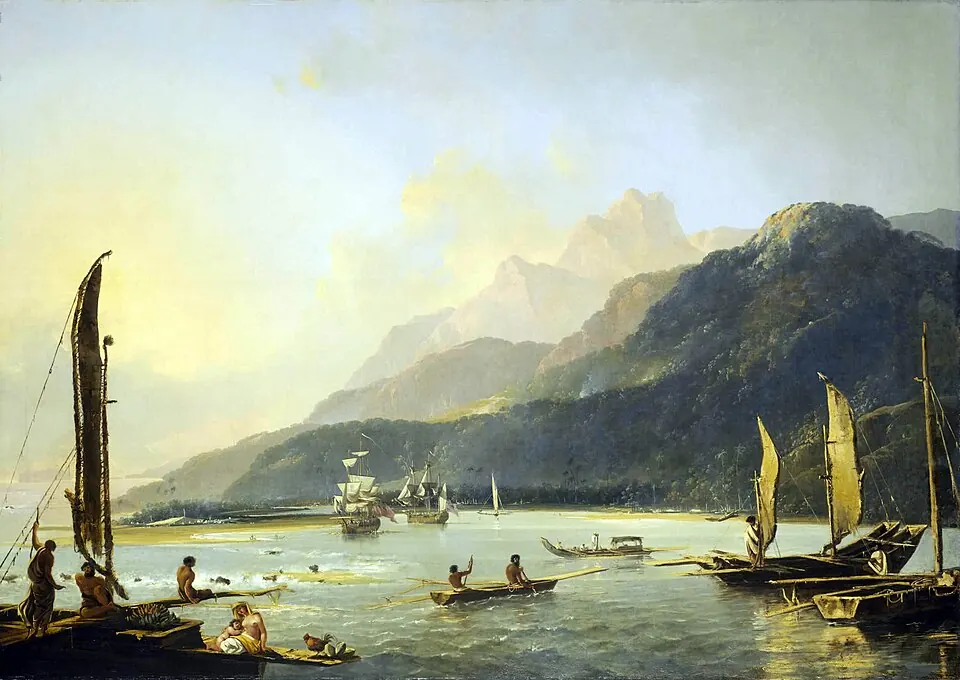
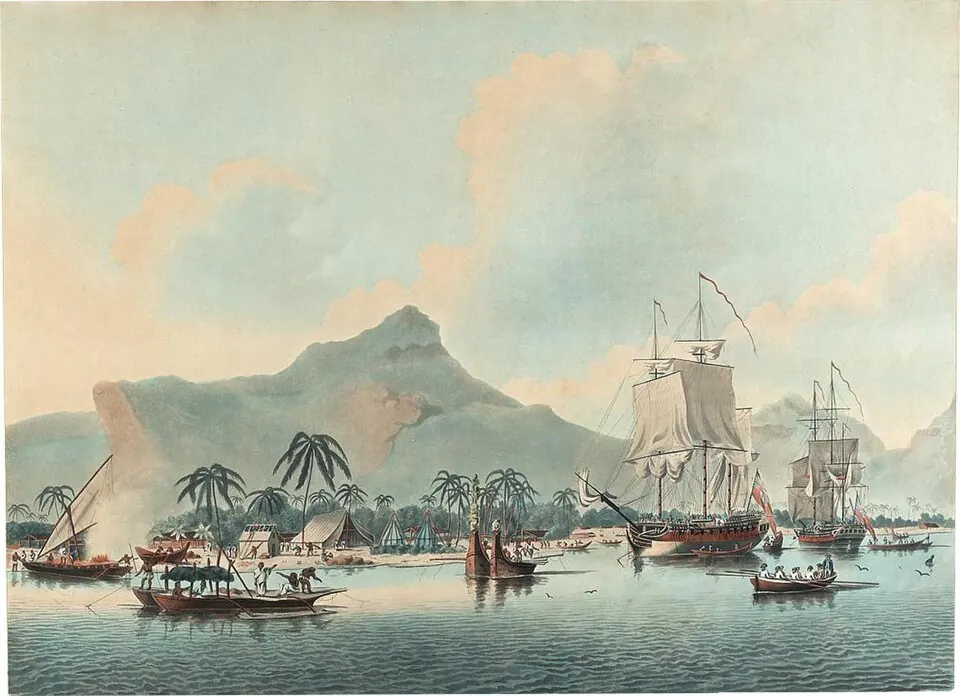
Resolution and Adventure with Tahitian fishing craft in Matavai Bay; a second-voyage painting. William Hodges · Public domain.
In July 1772, Resolution and Adventure set out from Plymouth. Johann Reinhold Forster and his son Georg join the scientific work, while William Hodges records landscapes and encounters. After provisioning at the Cape, the ships press south into cold, fog and floating ice. This time the search for a southern continent will test the crews’ endurance as much as their navigation.
Historical dates and route context
The story reuses the three Pacific voyages in Explorations. Selected dated stages and offshore corridors are schematic reconstructions, not daily log positions. Repeated positions represent documented stays and repairs; most minor landfalls are omitted. Journal and civil dates can differ by a day. The two-ship expeditions are represented by a vessel-class marker following the lead ship’s selected route; detached ships do not have independently reconstructed tracks. After Cook’s death, the third track follows the surviving expedition under Clerke and Gore. Modern borders do not imply historic sovereignty or consent to British claims.
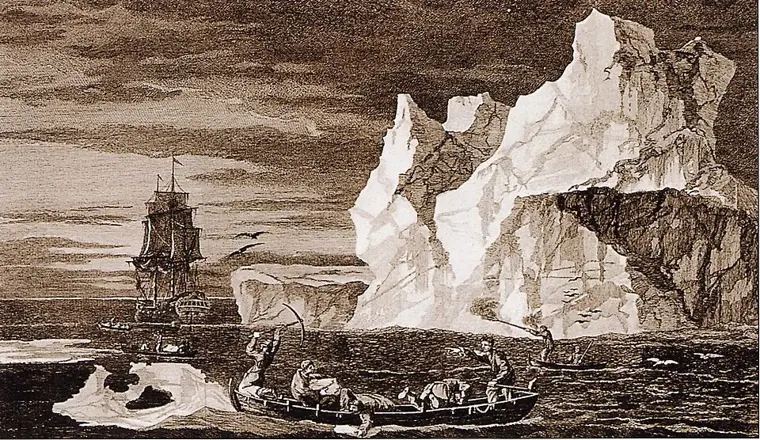
Ice islands encountered by Cook’s second expedition in January 1773. William Hodges · Public domain.
In January 1773, the expedition crosses the Antarctic Circle. Ice closes the way, forcing changes of course. Boats collect loose ice to melt into drinking water, turning a danger into a supply. Fog separates the two ships in February. Resolution eventually heads towards New Zealand, where shelter, repairs and fresh provisions can restore a crew that has spent months at sea.
Historical dates and route context
The story reuses the three Pacific voyages in Explorations. Selected dated stages and offshore corridors are schematic reconstructions, not daily log positions. Repeated positions represent documented stays and repairs; most minor landfalls are omitted. Journal and civil dates can differ by a day. The two-ship expeditions are represented by a vessel-class marker following the lead ship’s selected route; detached ships do not have independently reconstructed tracks. After Cook’s death, the third track follows the surviving expedition under Clerke and Gore. Modern borders do not imply historic sovereignty or consent to British claims.
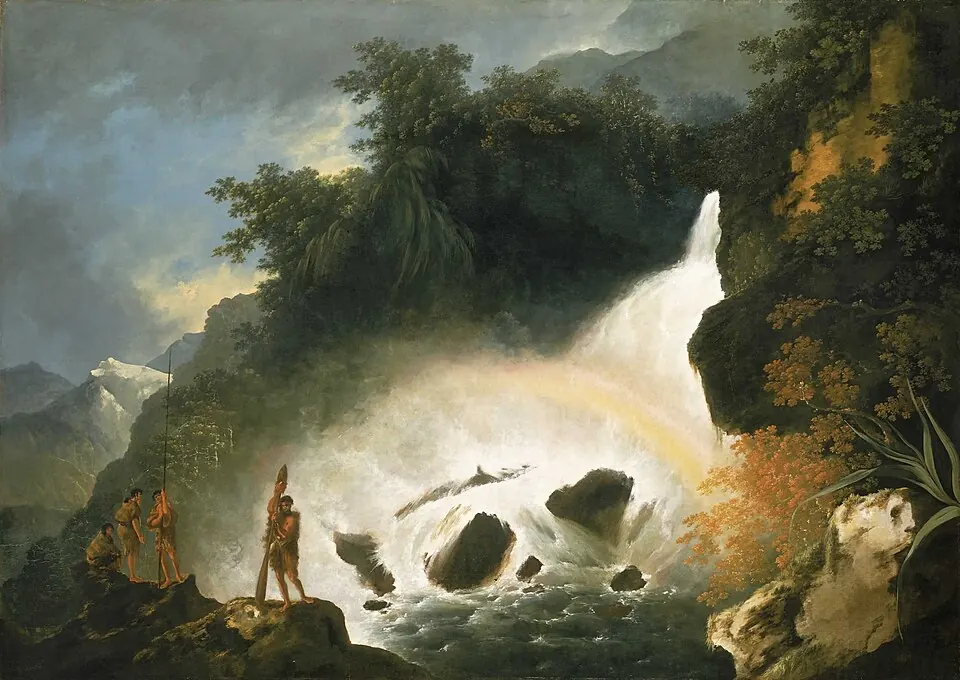
Cascade Cove, Dusky Bay, painted from the second voyage. William Hodges · Public domain.
At Tamatea, or Dusky Sound, the men repair sails and rigging, fish and collect plants. An observatory goes ashore, and Hodges sketches the landscape. Exchanges with Māori take place alongside the work of refitting. Resolution later rejoins Adventure at Queen Charlotte Sound. The ships sail into the tropical Pacific, returning to Tahiti before reaching Tonga, where provisioning again depends on relationships ashore.
Historical dates and route context
The story reuses the three Pacific voyages in Explorations. Selected dated stages and offshore corridors are schematic reconstructions, not daily log positions. Repeated positions represent documented stays and repairs; most minor landfalls are omitted. Journal and civil dates can differ by a day. The two-ship expeditions are represented by a vessel-class marker following the lead ship’s selected route; detached ships do not have independently reconstructed tracks. After Cook’s death, the third track follows the surviving expedition under Clerke and Gore. Modern borders do not imply historic sovereignty or consent to British claims.
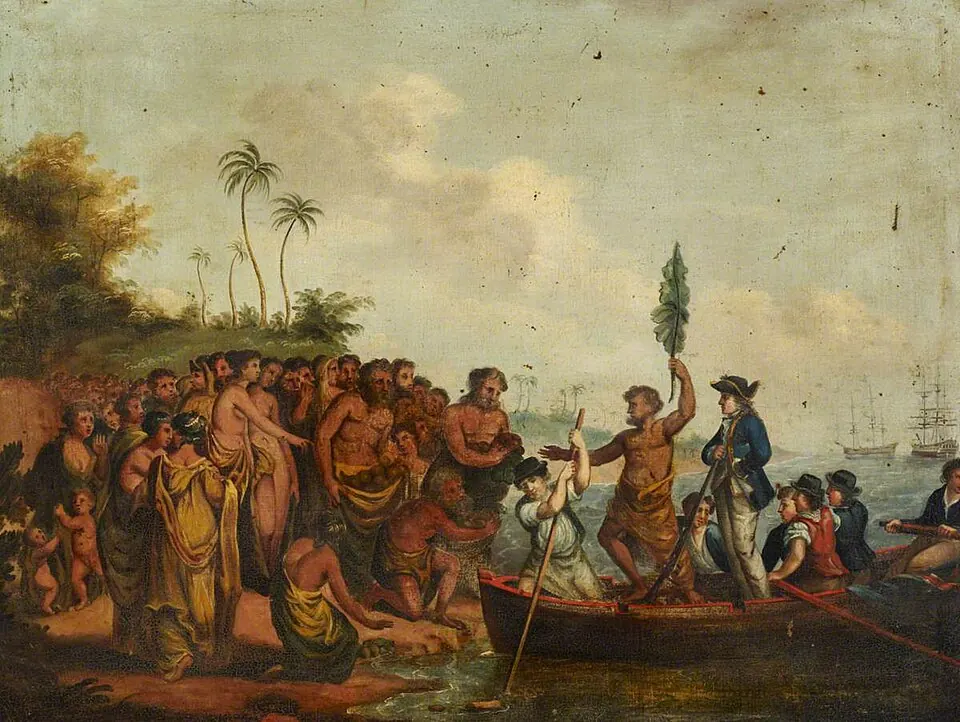
A historical depiction of Cook’s landing at Middleburg, now ʻEua, Tonga. Anonymous, after William Hodges · Public domain.
In Tonga, food and welcome are part of an island society with powerful leaders and its own interests in exchange. Cook’s description of the Friendly Islands will outlast these visits. The voyage then returns to New Zealand; the ships become separated again, and Resolution continues alone. In January 1774, Cook reaches beyond seventy-one degrees south before ice forces a retreat. Warmer waters, and Rapa Nui, lie ahead.
Historical dates and route context
The story reuses the three Pacific voyages in Explorations. Selected dated stages and offshore corridors are schematic reconstructions, not daily log positions. Repeated positions represent documented stays and repairs; most minor landfalls are omitted. Journal and civil dates can differ by a day. The two-ship expeditions are represented by a vessel-class marker following the lead ship’s selected route; detached ships do not have independently reconstructed tracks. After Cook’s death, the third track follows the surviving expedition under Clerke and Gore. Modern borders do not imply historic sovereignty or consent to British claims.
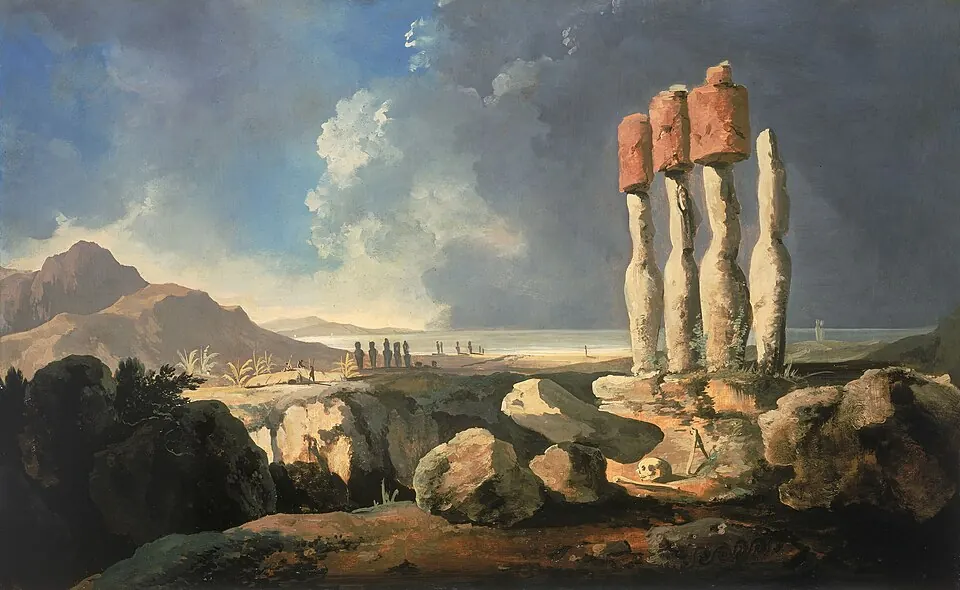
A View of the Monuments of Easter Island, Rapanui, by William Hodges. William Hodges · Public domain.
At Rapa Nui, the crew encounters the great stone figures and the people whose ancestors made them. Hodges records what he sees, while a short stay allows limited exploration and provisioning. The voyage continues through the Marquesas, Tahiti, Tonga and Melanesia. Each call brings observations and collections, but also negotiations and sometimes violence. Before sailing for home, Cook returns once more to New Zealand.
Historical dates and route context
The story reuses the three Pacific voyages in Explorations. Selected dated stages and offshore corridors are schematic reconstructions, not daily log positions. Repeated positions represent documented stays and repairs; most minor landfalls are omitted. Journal and civil dates can differ by a day. The two-ship expeditions are represented by a vessel-class marker following the lead ship’s selected route; detached ships do not have independently reconstructed tracks. After Cook’s death, the third track follows the surviving expedition under Clerke and Gore. Modern borders do not imply historic sovereignty or consent to British claims.
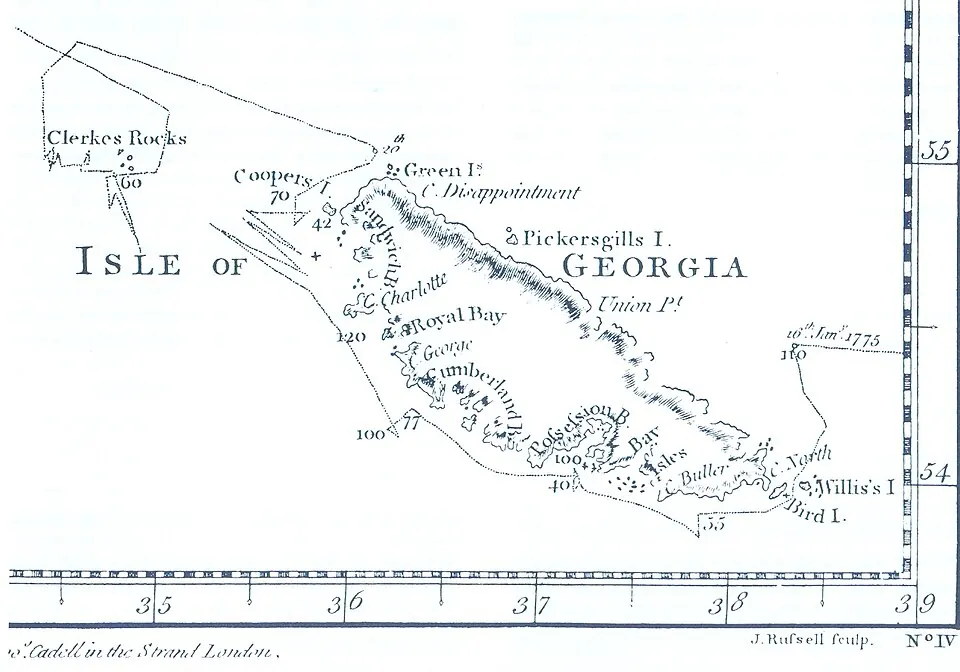
Cook’s published chart of South Atlantic discoveries, including South Georgia. James Cook; engraved by William Palmer · Public domain.
After leaving New Zealand and rounding Cape Horn, Resolution reaches South Georgia. Its mountains and ice offer no hospitable southern continent. Farther east lie the South Sandwich Islands. Cook’s long sweep through southern waters has undermined the idea of a vast, temperate landmass there, although Antarctica itself remains unseen. The ship now heads towards the Cape and then England, completing the second voyage in July 1775.
Historical dates and route context
The story reuses the three Pacific voyages in Explorations. Selected dated stages and offshore corridors are schematic reconstructions, not daily log positions. Repeated positions represent documented stays and repairs; most minor landfalls are omitted. Journal and civil dates can differ by a day. The two-ship expeditions are represented by a vessel-class marker following the lead ship’s selected route; detached ships do not have independently reconstructed tracks. After Cook’s death, the third track follows the surviving expedition under Clerke and Gore. Modern borders do not imply historic sovereignty or consent to British claims.
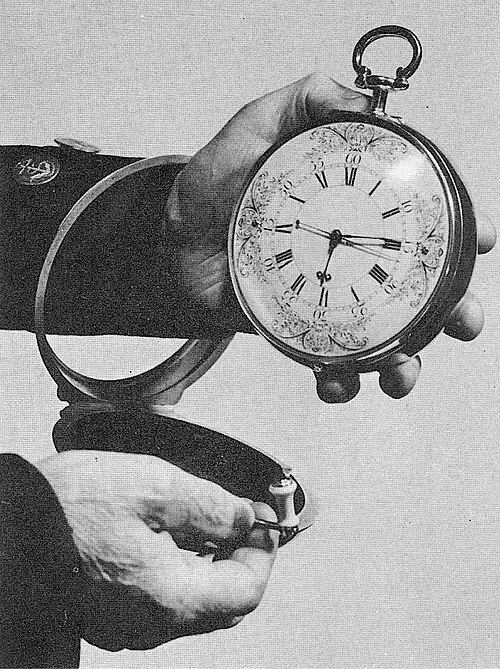
Kendall’s K1 marine chronometer, carried on Cook’s second and third voyages; a museum photograph. UK National Maritime Museum; instrument by Larcum Kendall · Public domain.
Back in England, the voyage offers practical lessons as well as new charts. Larcum Kendall’s K1 timekeeper has helped Cook check longitude against astronomical observations. Fresh food obtained along the way, cleanliness and strict routines have helped protect the crew’s health. There is no single miraculous cure in the ship’s stores. Yet Cook’s time ashore is short: another expedition will seek a northern route between the Pacific and Atlantic.
Historical dates and route context
The story reuses the three Pacific voyages in Explorations. Selected dated stages and offshore corridors are schematic reconstructions, not daily log positions. Repeated positions represent documented stays and repairs; most minor landfalls are omitted. Journal and civil dates can differ by a day. The two-ship expeditions are represented by a vessel-class marker following the lead ship’s selected route; detached ships do not have independently reconstructed tracks. After Cook’s death, the third track follows the surviving expedition under Clerke and Gore. Modern borders do not imply historic sovereignty or consent to British claims.
Resolution and Discovery off Huahine in a later print; the ships of the third voyage. Francis Jukes after John Cleveley the Younger · Public domain.
Resolution sails again in 1776, with Discovery joining the expedition. The aim is a Northwest Passage, a sea route through northern America. But reaching the search area means another long passage via southern Africa, Tasmania and New Zealand. Leaking ships, weather and the needs of animals carried aboard complicate progress. Long stays in Tonga and the Society Islands follow before Cook finally turns north.
Historical dates and route context
The story reuses the three Pacific voyages in Explorations. Selected dated stages and offshore corridors are schematic reconstructions, not daily log positions. Repeated positions represent documented stays and repairs; most minor landfalls are omitted. Journal and civil dates can differ by a day. The two-ship expeditions are represented by a vessel-class marker following the lead ship’s selected route; detached ships do not have independently reconstructed tracks. After Cook’s death, the third track follows the surviving expedition under Clerke and Gore. Modern borders do not imply historic sovereignty or consent to British claims.
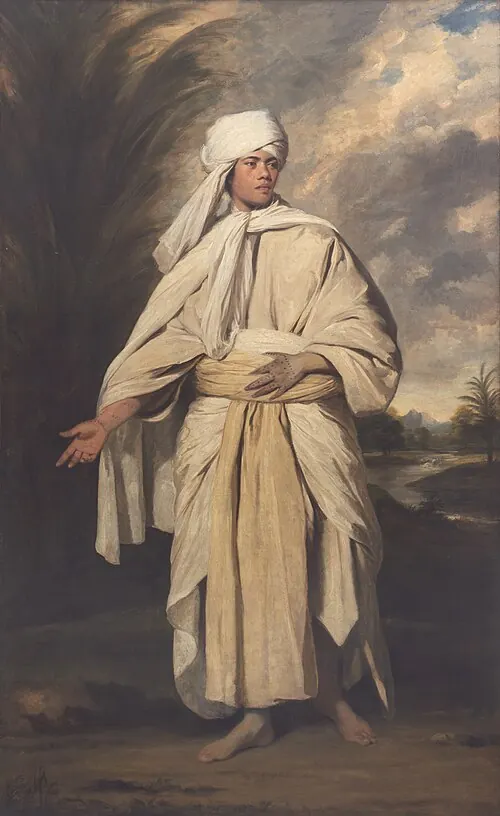
Mai, often called Omai, portrayed in Britain by Joshua Reynolds. Joshua Reynolds · Public domain.
Mai, often called Omai in Britain, returns to the Society Islands with Cook. He has travelled to England aboard Adventure and been celebrated in fashionable society. His own future matters more than that celebrity: Cook helps establish him on Huahine. The expedition moves on, visiting Kauaʻi in January 1778 before continuing towards North America. It is entering another ocean of established settlements, farming, trade and navigation.
Historical dates and route context
The story reuses the three Pacific voyages in Explorations. Selected dated stages and offshore corridors are schematic reconstructions, not daily log positions. Repeated positions represent documented stays and repairs; most minor landfalls are omitted. Journal and civil dates can differ by a day. The two-ship expeditions are represented by a vessel-class marker following the lead ship’s selected route; detached ships do not have independently reconstructed tracks. After Cook’s death, the third track follows the surviving expedition under Clerke and Gore. Modern borders do not imply historic sovereignty or consent to British claims.
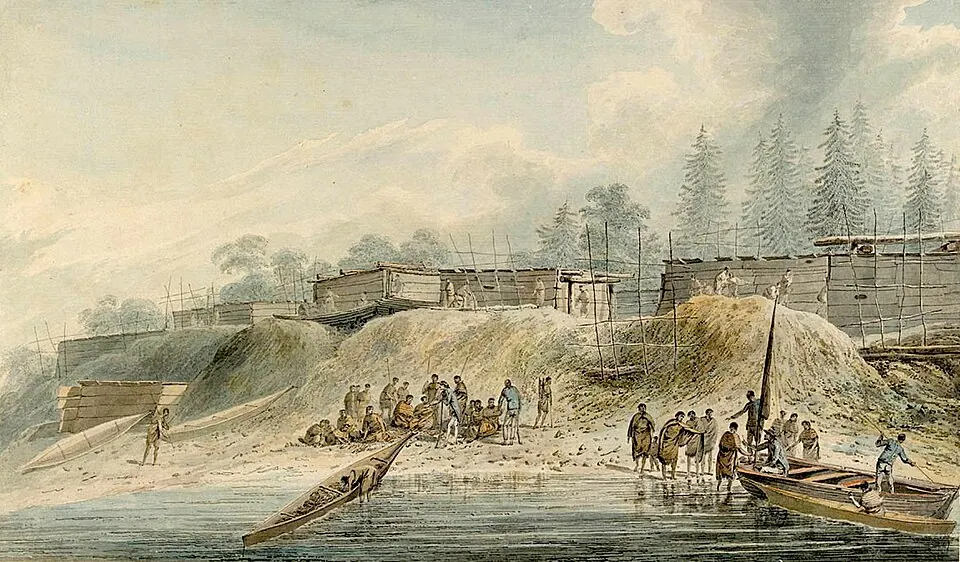
Habitations at Nootka Sound, after John Webber’s third-voyage drawing. John Webber; published engraving · Public domain.
At Nootka Sound, the ships spend about a month repairing and obtaining supplies. This is Mowachaht country, within the wider Nuu-chah-nulth world, where the sea sustains established communities. Exchanges include sea-otter pelts that will later attract commercial interest. Cook then explores north along the coast of Alaska. Inlets must be investigated and abandoned before the ships can enter the Bering Sea and approach Arctic waters.
Historical dates and route context
The story reuses the three Pacific voyages in Explorations. Selected dated stages and offshore corridors are schematic reconstructions, not daily log positions. Repeated positions represent documented stays and repairs; most minor landfalls are omitted. Journal and civil dates can differ by a day. The two-ship expeditions are represented by a vessel-class marker following the lead ship’s selected route; detached ships do not have independently reconstructed tracks. After Cook’s death, the third track follows the surviving expedition under Clerke and Gore. Modern borders do not imply historic sovereignty or consent to British claims.
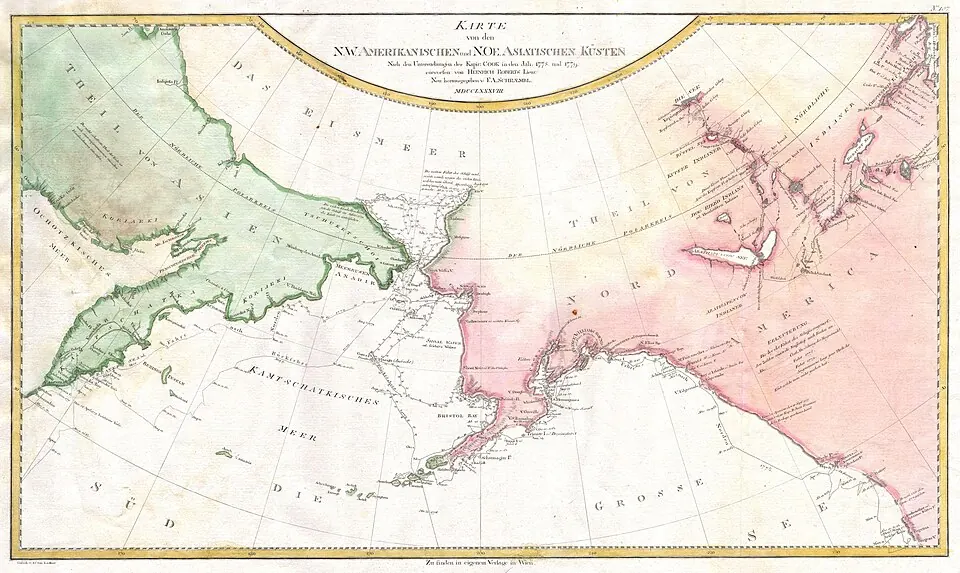
A later chart of the North Pacific incorporating Cook’s 1778–1779 surveys. Franz Anton Schraembl · Public domain.
Even in summer, pack ice blocks the expedition’s northern progress. There is no open highway through the Arctic. The ships turn back, exploring more coastline and meeting Russian traders at Unalaska, who share charts and information. Repairs and fresh supplies remain urgent. With the season ending, Cook sails south towards Hawaiʻi, where canoes will bring provisions before the ships finally anchor in Kealakekua Bay.
Historical dates and route context
The story reuses the three Pacific voyages in Explorations. Selected dated stages and offshore corridors are schematic reconstructions, not daily log positions. Repeated positions represent documented stays and repairs; most minor landfalls are omitted. Journal and civil dates can differ by a day. The two-ship expeditions are represented by a vessel-class marker following the lead ship’s selected route; detached ships do not have independently reconstructed tracks. After Cook’s death, the third track follows the surviving expedition under Clerke and Gore. Modern borders do not imply historic sovereignty or consent to British claims.
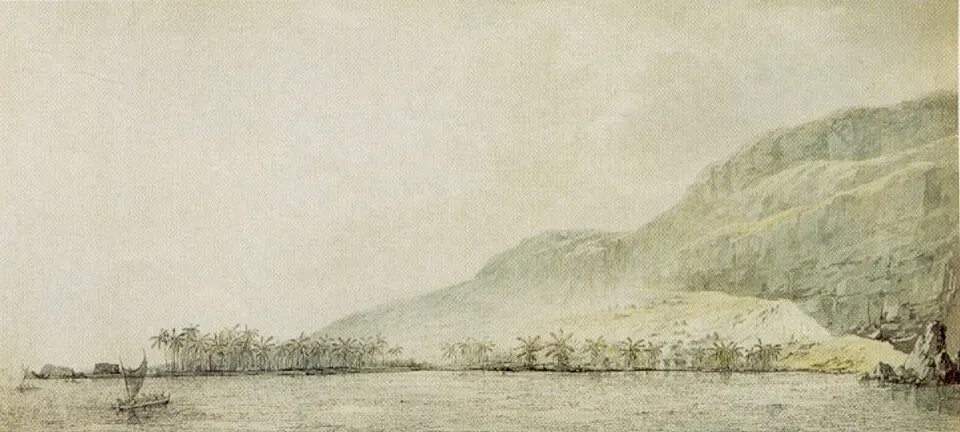
Kealakekua Bay and the village of Kaʻawaloa, drawn by John Webber. John Webber · Public domain.
At Kealakekua Bay, Hawaiian leaders welcome the ships with food and gifts during the Makahiki season. These exchanges take place within a sovereign society, not under British authority. The demands of two ships and disputes with their crews strain relations. Cook leaves in February, but damage to Resolution’s mast brings the expedition back. The second reception is more troubled, and the theft of a boat will trigger a dangerous confrontation.
Historical dates and route context
The story reuses the three Pacific voyages in Explorations. Selected dated stages and offshore corridors are schematic reconstructions, not daily log positions. Repeated positions represent documented stays and repairs; most minor landfalls are omitted. Journal and civil dates can differ by a day. The two-ship expeditions are represented by a vessel-class marker following the lead ship’s selected route; detached ships do not have independently reconstructed tracks. After Cook’s death, the third track follows the surviving expedition under Clerke and Gore. Modern borders do not imply historic sovereignty or consent to British claims.
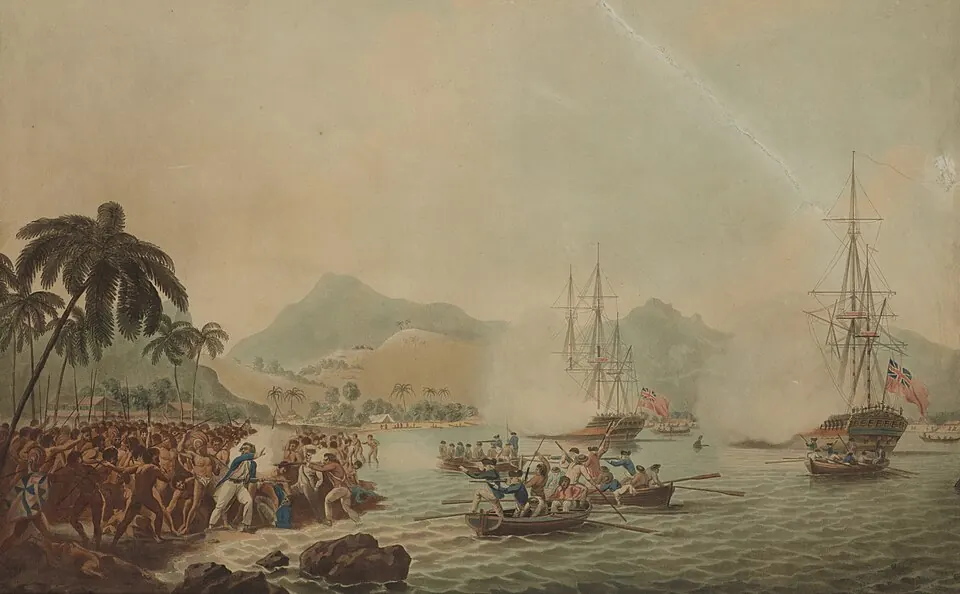
A later interpretation of Cook’s death, not an impartial eyewitness record. Francis Jukes after John Cleveley the Younger · Public domain.
Cook goes ashore to take the ruling chief Kalaniʻōpuʻu hostage, hoping to force the return of the stolen boat. Hawaiians resist the attempt to remove their leader. The confrontation turns violent; Cook, four marines and Hawaiians are killed. Accounts differ in their details. Later pictures will turn the episode into a heroic death scene, but its immediate cause includes an attempted seizure of Hawaiian authority.
Historical dates and route context
The story reuses the three Pacific voyages in Explorations. Selected dated stages and offshore corridors are schematic reconstructions, not daily log positions. Repeated positions represent documented stays and repairs; most minor landfalls are omitted. Journal and civil dates can differ by a day. The two-ship expeditions are represented by a vessel-class marker following the lead ship’s selected route; detached ships do not have independently reconstructed tracks. After Cook’s death, the third track follows the surviving expedition under Clerke and Gore. Modern borders do not imply historic sovereignty or consent to British claims.
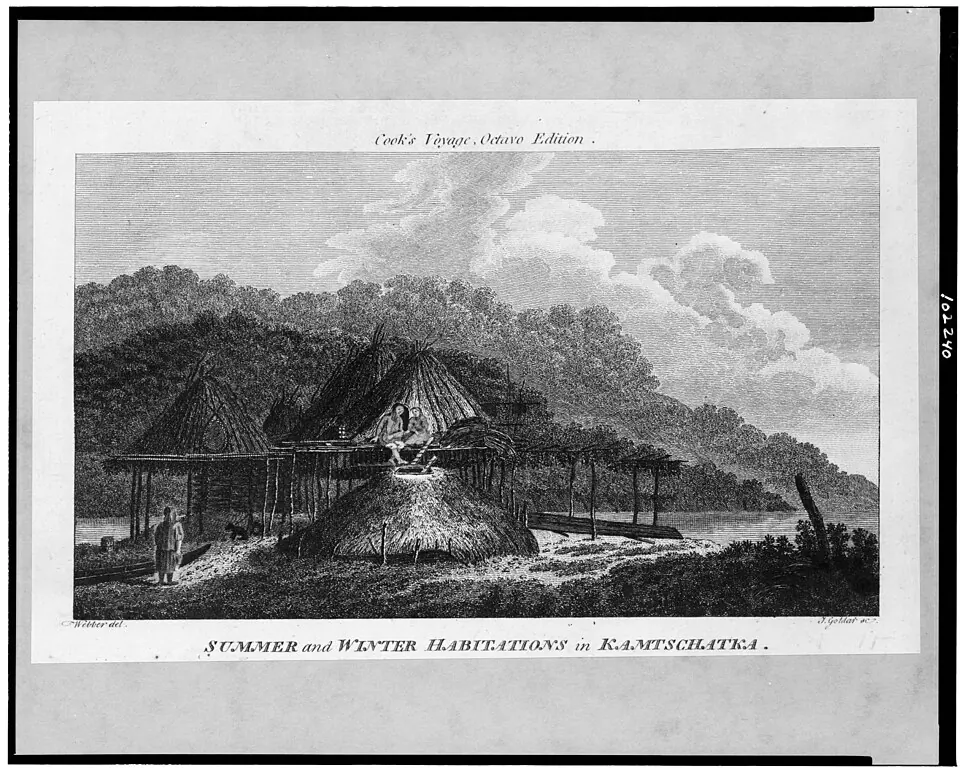
Summer and winter dwellings in Kamchatka, visited by the returning third expedition. John Goldar after John Webber · Public domain.
Charles Clerke takes command and continues the mission. The ships sail towards Kamchatka, then make another unsuccessful Arctic attempt. Clerke dies in August 1779, and John Gore leads the homeward voyage. The crews obtain supplies near Macao, cross the Indian Ocean and repair at the Cape. Storms delay their return around Britain. In October 1780, they finally reach the Thames, carrying the records of a voyage Cook did not live to finish.
Historical dates and route context
The story reuses the three Pacific voyages in Explorations. Selected dated stages and offshore corridors are schematic reconstructions, not daily log positions. Repeated positions represent documented stays and repairs; most minor landfalls are omitted. Journal and civil dates can differ by a day. The two-ship expeditions are represented by a vessel-class marker following the lead ship’s selected route; detached ships do not have independently reconstructed tracks. After Cook’s death, the third track follows the surviving expedition under Clerke and Gore. Modern borders do not imply historic sovereignty or consent to British claims.
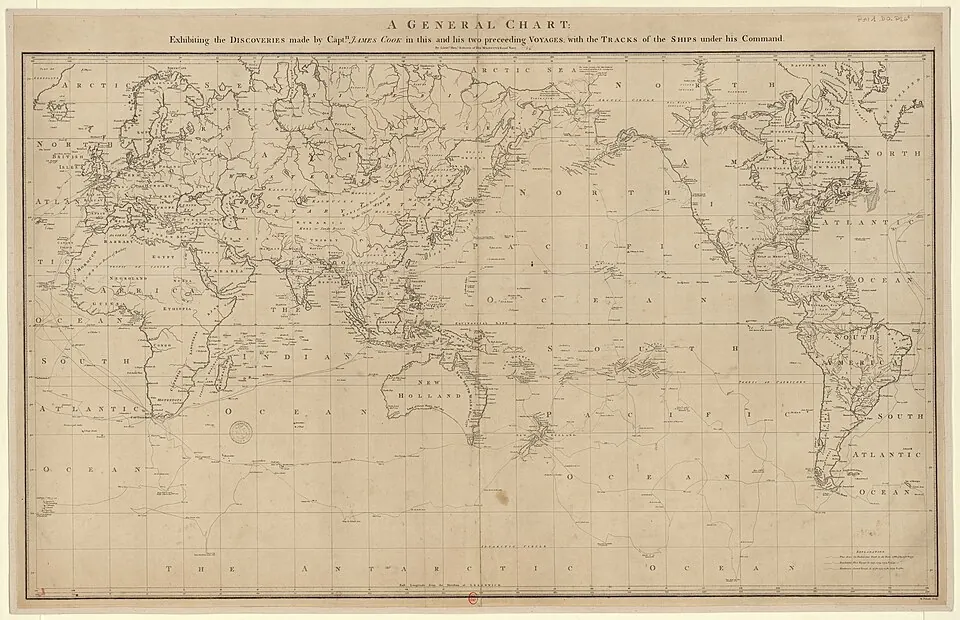
A published chart bringing together the tracks of Cook’s three Pacific voyages. Henry Roberts; engraved by William Palmer · Public domain.
The returning ships bring charts, specimens, artworks and accounts of Pacific societies to a wide European audience. Cook’s surveying changes navigation, but his voyages also advance imperial ambitions. Knowledge from the first voyage helps prepare Britain’s later colonisation of Australia. Tupaia, Mai, island communities and the crews belong in this history alongside its famous captain. The ocean they crossed was never an empty space waiting to be found.
Historical dates and route context
The story reuses the three Pacific voyages in Explorations. Selected dated stages and offshore corridors are schematic reconstructions, not daily log positions. Repeated positions represent documented stays and repairs; most minor landfalls are omitted. Journal and civil dates can differ by a day. The two-ship expeditions are represented by a vessel-class marker following the lead ship’s selected route; detached ships do not have independently reconstructed tracks. After Cook’s death, the third track follows the surviving expedition under Clerke and Gore. Modern borders do not imply historic sovereignty or consent to British claims.