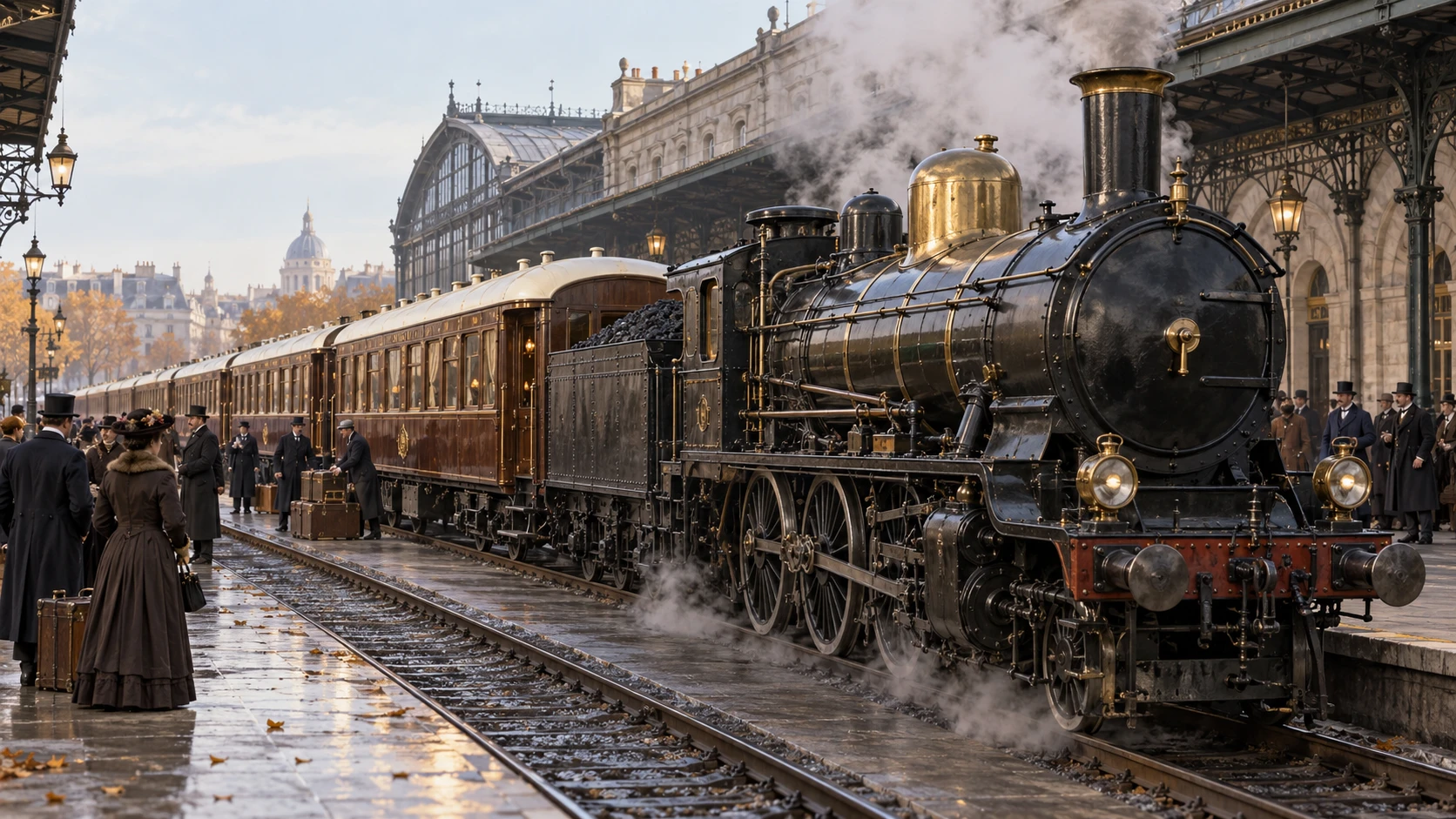
AI-generated historical reconstruction of an 1883 steam-hauled Orient Express departure. Representative train and setting, not an archival photograph or verified locomotive.
The Orient Express is a luxury international train service created in 1883 to link Paris with Constantinople, today Istanbul. Conceived as a hotel on wheels, it brings sleeping compartments, dining and coordinated connections to a journey across Europe. We will follow its original route, when passengers still need a Danube ferry, another train and a Black Sea steamer to reach their destination. Our journey begins in Paris in October 1883.
Historical dates and route context
The itinerary and transfers are historical. Intermediate dates, hours and positions are illustrative narrative timing, not a verified October 1883 timetable. Route lines are schematic; stops are storytelling pauses, not evidence of sightseeing excursions. Country shading uses present-day outlines.
Nancy’s Place Stanislas in an 1855 travel-guide illustration, attributed to Hippolyte-Jules Demolière. Public domain.
Beyond Paris, the train crosses eastern France towards Nancy. The sleeping car changes what distance feels like: passengers can dine and retire while railway workers continue the journey through the night. At Nancy, the grand international service depends on the same everyday railway work that keeps smaller cities connected. Smaller cities, junctions, kitchens, workshops and crews make the grand itinerary possible. The March 1883 agreement binds several railway administrations to the same undertaking. Behind the romance lies the difficult business of making connections work across borders.
Historical dates and route context
The itinerary and transfers are historical. Intermediate dates, hours and positions are illustrative narrative timing, not a verified October 1883 timetable. Route lines are schematic; stops are storytelling pauses, not evidence of sightseeing excursions. Country shading uses present-day outlines.
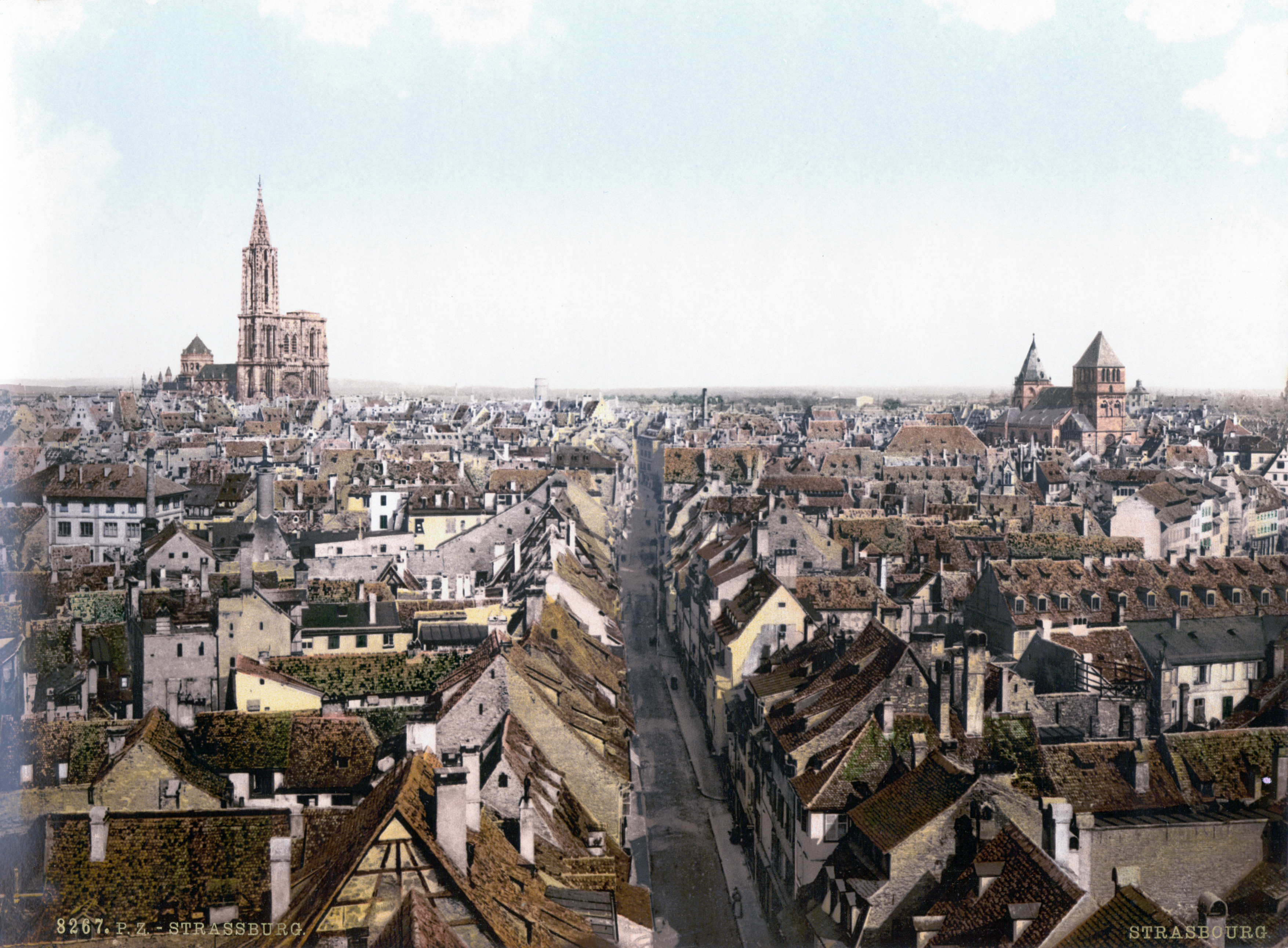
Strasbourg in a photochrom dated 1890–1905, after this journey. Library of Congress, ppmsca.00011. Public domain.
Strasbourg is not in France on this journey. Annexed after the Franco-Prussian War, it belongs to the German Empire in 1883. Its cathedral and older streets coexist with a new imperial district taking shape beyond the historic centre. The train’s passengers cross a political frontier without leaving their sleeping-car world entirely behind. A railway itinerary can outlast the borders around it; here, the city’s changing allegiance makes that visible. Beyond the old streets, the expanding Neustadt reflects Strasbourg’s new place within the German Empire.
Historical dates and route context
The itinerary and transfers are historical. Intermediate dates, hours and positions are illustrative narrative timing, not a verified October 1883 timetable. Route lines are schematic; stops are storytelling pauses, not evidence of sightseeing excursions. Country shading uses present-day outlines.
Stuttgart · the hidden work of international travel
Inside the old Stuttgart station: nineteenth-century photograph, exact year unknown. Unknown photographer. Public domain.
Stuttgart brings the journey into Württemberg, one of the states within the German Empire. The service is international, but it is not hauled from Paris to the Black Sea by a single locomotive. Different railway administrations supply the infrastructure and working arrangements along the way. The continuity belongs to the passenger experience and the coordinated service. Outside the luxury compartments, railway staff, cooks, porters and crews work to keep the travellers moving.
Historical dates and route context
The itinerary and transfers are historical. Intermediate dates, hours and positions are illustrative narrative timing, not a verified October 1883 timetable. Route lines are schematic; stops are storytelling pauses, not evidence of sightseeing excursions. Country shading uses present-day outlines.
Munich from the Maximilianeum, photochrom dated 1890–1905, after this journey. Library of Congress, ppmsca.00057. Public domain.
Munich offers a different face of the German Empire: the capital of the Kingdom of Bavaria. The first wing of its New Town Hall is already standing, built between 1867 and 1873, but the great tower familiar to modern visitors belongs to a later expansion. The journey continues towards Austria, carrying its guests between royal capitals while the railway makes overnight travel increasingly practical. Munich is still growing into the city later generations will recognise.
Historical dates and route context
The itinerary and transfers are historical. Intermediate dates, hours and positions are illustrative narrative timing, not a verified October 1883 timetable. Route lines are schematic; stops are storytelling pauses, not evidence of sightseeing excursions. Country shading uses present-day outlines.
Vienna’s Ringstrasse and Parliament in 1890, seven years after the journey. Photograph by Viktor Angerer. Public domain.
Beyond Munich, the train heads east through Mühldorf to the frontier at Simbach and Braunau. This original route stays north of Salzburg. It joins the line through Wels and Linz before approaching Vienna, the capital of the Austrian half of Austria-Hungary. Around its old centre, the Ringstrasse announces imperial ambition through broad boulevards and monumental buildings. Inaugurated in 1865, the boulevard is still being transformed. The same age that reshapes the capital is building the railway connections that bring us here.
Historical dates and route context
The itinerary and transfers are historical. Intermediate dates, hours and positions are illustrative narrative timing, not a verified October 1883 timetable. Route lines are schematic; stops are storytelling pauses, not evidence of sightseeing excursions. Country shading uses present-day outlines.
Buda Castle and the Danube, photochrom dated 1890–1900, after this journey. Library of Congress, ppmsc.09478. Public domain.
Leaving Vienna, the original express runs through Marchegg and Pressburg, today Bratislava, before turning towards Budapest. Buda, Pest and Óbuda united in 1873, only ten years before this journey. On opposite sides of the Danube, hills and broad streets give the young capital contrasting faces. We approach the city on the railway into Pest. The monumental Keleti station familiar to later travellers is not yet open in 1883. Ahead lie the Hungarian plain and the long southern route into Romania.
Historical dates and route context
The itinerary and transfers are historical. Intermediate dates, hours and positions are illustrative narrative timing, not a verified October 1883 timetable. Route lines are schematic; stops are storytelling pauses, not evidence of sightseeing excursions. Country shading uses present-day outlines.
Bucharest, photochrom dated 1890–1900, after this journey. Library of Congress, ppmsc.06094. Public domain.
Beyond Budapest, the train crosses the plain towards Szeged, then continues through Timișoara and the valleys leading to Orșova. It does not take a straight line over the Transylvanian mountains. From the Danube frontier, the railway curves through Craiova, Slatina and Pitești towards Bucharest. Romania became a kingdom in 1881, just two years before our journey. Its capital is connecting itself to a wider continent through railways, trade and diplomacy. As Bucharest approaches, the final stretch of our through-train journey is coming into view.
Historical dates and route context
The itinerary and transfers are historical. Intermediate dates, hours and positions are illustrative narrative timing, not a verified October 1883 timetable. Route lines are schematic; stops are storytelling pauses, not evidence of sightseeing excursions. Country shading uses present-day outlines.
Giurgiu’s recent wartime past: a Cossack camp under shellfire, Illustrated London News, 7 July 1877. Context image, six years before the peaceful 1883 journey. Public domain.
The Paris train reaches Giurgiu on the Romanian bank of the Danube. Here the promise of a seamless journey meets the geography of an unfinished railway system. Passengers must leave their through carriages and cross the river. Giurgiu is the endpoint of the through train from Paris. Constantinople remains the destination of the overall journey, but it is not yet reachable by staying in this train. The river is both a frontier and a transport route in its own right.
Historical dates and route context
The itinerary and transfers are historical. Intermediate dates, hours and positions are illustrative narrative timing, not a verified October 1883 timetable. Route lines are schematic; stops are storytelling pauses, not evidence of sightseeing excursions. Country shading uses present-day outlines.
People of the Danube region: staged costume portrait, 1873, including a woman identified as from Ruse. Pascal Sébah; Library of Congress cph.3g11742. Regional context, not a photograph of the ferry. Public domain.
The crossing takes the travellers to Ruse, then often called Rustchuk, on the southern bank. The ferry is an essential part of this itinerary; there is no continuous railway crossing here for these passengers in 1883. From the water, the luxury express looks less like one machine and more like a chain of carefully arranged connections. Steam power works on the river as well as on land. Luggage and passengers must reach the next train, while the Danube continues its much older role as a corridor of trade and travel.
Historical dates and route context
The itinerary and transfers are historical. Intermediate dates, hours and positions are illustrative narrative timing, not a verified October 1883 timetable. Route lines are schematic; stops are storytelling pauses, not evidence of sightseeing excursions. Country shading uses present-day outlines.
Kaspichan station in 1866, on Bulgaria’s first railway between Ruse and Varna. Unknown photographer. Public domain.
At Ruse, passengers join another train for Varna. This line opened in 1866, the first railway in what is now Bulgaria. It links the Danube to the Black Sea and turns Ruse into an important gateway. In 1883, Bulgaria is an autonomous principality under Ottoman suzerainty, rather than the fully independent kingdom it will later become. The final rail leg therefore passes through another changing political landscape. Ruse’s river trade and Varna’s port make the connection valuable well beyond the handful of guests travelling in luxury.
Historical dates and route context
The itinerary and transfers are historical. Intermediate dates, hours and positions are illustrative narrative timing, not a verified October 1883 timetable. Route lines are schematic; stops are storytelling pauses, not evidence of sightseeing excursions. Country shading uses present-day outlines.
Varna’s port in October 1912, 29 years after this journey; harbour facilities had changed. Agence Rol / Bibliothèque nationale de France. Public domain.
At Varna, the journey changes character again. An ancient Black Sea port, known in antiquity as Odessos, now provides the connection that the railway cannot yet complete. The travellers transfer to the steamer Espero for Constantinople; the sea passage takes about fifteen hours. For centuries, Varna has connected the Black Sea with the lands inland. Its harbour now carries these railway passengers on the final leg to Constantinople. From here, the coast and the entrance to the Bosphorus replace the railway window.
Historical dates and route context
The itinerary and transfers are historical. Intermediate dates, hours and positions are illustrative narrative timing, not a verified October 1883 timetable. Route lines are schematic; stops are storytelling pauses, not evidence of sightseeing excursions. Country shading uses present-day outlines.
Constantinople and the Golden Horn, photochrom by Photoglob Zürich, 1890–1900, after this journey. Library of Congress. Public domain.
The railway falls behind us as the steamer Espero leaves Varna for Constantinople. Across the Black Sea, the journey continues under steam, but now the rhythm is that of a ship. After the coastal passage, we enter the Bosphorus from the north and follow its narrowing waters towards the Ottoman capital. Today we know the city as Istanbul. Its hills, waterfronts and the Golden Horn are the final reveal after sleeping cars, borders, a river ferry and a second train. We arrive by water; the monumental Sirkeci station belongs to a later chapter, opening in 1890.
Historical dates and route context
The itinerary and transfers are historical. Intermediate dates, hours and positions are illustrative narrative timing, not a verified October 1883 timetable. Route lines are schematic; stops are storytelling pauses, not evidence of sightseeing excursions. Country shading uses present-day outlines.
The legend develops: an advertisement for winter 1888–1889, five years after the inaugural journey. Imp. Chaix; Bibliothèque nationale de France / Gallica. Public domain.
The first route shows why the Orient Express became more than a train name. It assembled railways, sleeping cars, dining, ferries and steamers into a journey across very different societies. In 1889 a direct all-rail route via Belgrade and Sofia changed the experience, removing these original water transfers from the Paris–Constantinople itinerary. For the first passengers in 1883, however, the river crossing and sea passage are essential parts of the adventure. The comfort inside the carriage rests on international agreements and the daily labour of people along the entire route.
Historical dates and route context
The itinerary and transfers are historical. Intermediate dates, hours and positions are illustrative narrative timing, not a verified October 1883 timetable. Route lines are schematic; stops are storytelling pauses, not evidence of sightseeing excursions. Country shading uses present-day outlines.