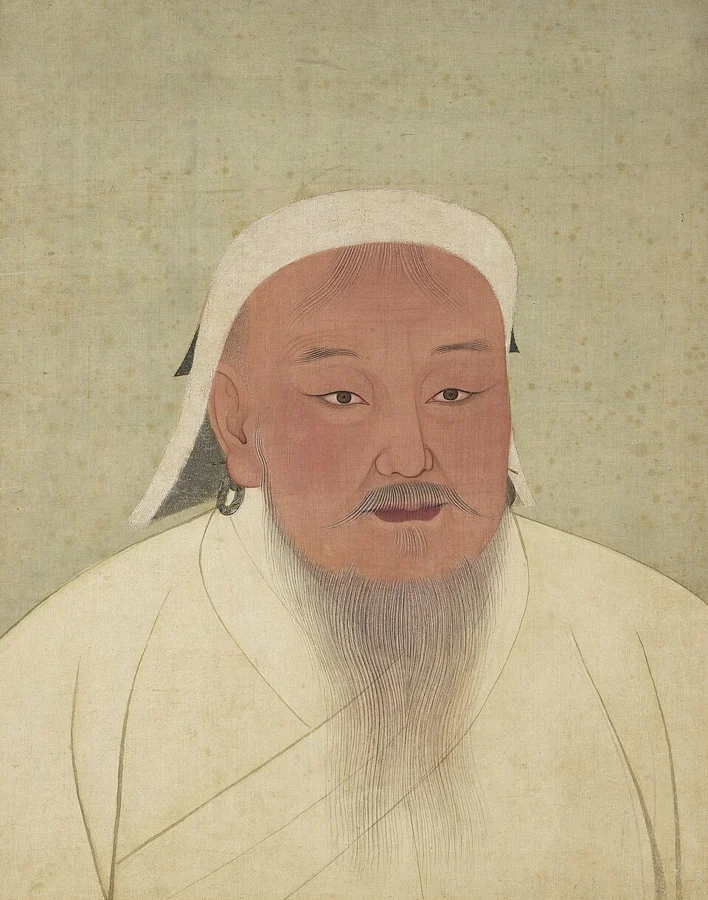
Posthumous Yuan-dynasty portrait of Chinggis Khan, fourteenth century; not an eyewitness portrait from 1206. Unknown authorUnknown author · Public domain.
The Mongol Empire began on the grasslands of Asia in 1206, when the leader Temujin became Chinggis Khan, better known as Genghis Khan. His armies and those of his successors created the largest connected land empire in history. This is a story of extraordinary organisation, devastating conquest and encounters between very different societies. We begin in Mongolia, then follow an expanding empire whose rulers eventually turn against one another.
Historical dates and route context
A chronological overview of separate campaigns, governments and themes, not one continuous expedition. Year-only milestones use editorial months and days. Territory shading is schematic: dated snapshots are not surveyed front lines. From 1260 it distinguishes selected successor states rather than one centrally governed empire; dashed Rus areas denote tributary relations. Campaigns do not imply lasting possession.
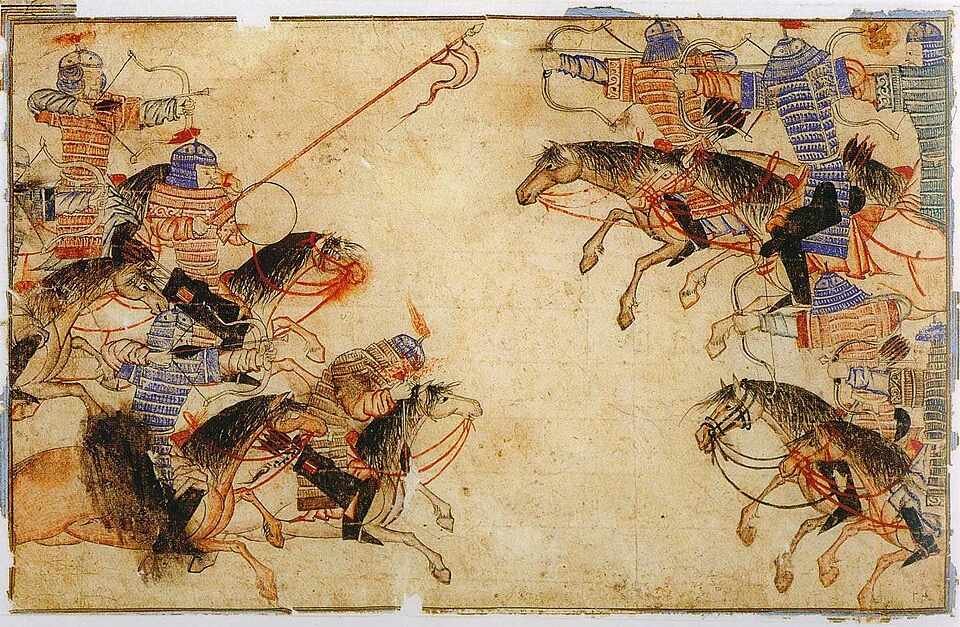
Mounted archers from the Diez Albums; historical manuscript artwork, not a record of this particular assembly or campaign. unknown / (of the reproduction) Staatsbibliothek Berlin/Schacht · Public domain.
Mounted archers can move quickly, but speed alone does not explain Mongol success. Chinggis Khan reorganises followers under commanders loyal to him, weakening older rivalries. Campaigns also draw on the knowledge of conquered peoples. Chinese siege specialists, Central Asian officials and many other recruits help turn a steppe army into a force capable of taking fortified cities and governing their inhabitants.
Historical dates and route context
A chronological overview of separate campaigns, governments and themes, not one continuous expedition. Year-only milestones use editorial months and days. Territory shading is schematic: dated snapshots are not surveyed front lines. From 1260 it distinguishes selected successor states rather than one centrally governed empire; dashed Rus areas denote tributary relations. Campaigns do not imply lasting possession.
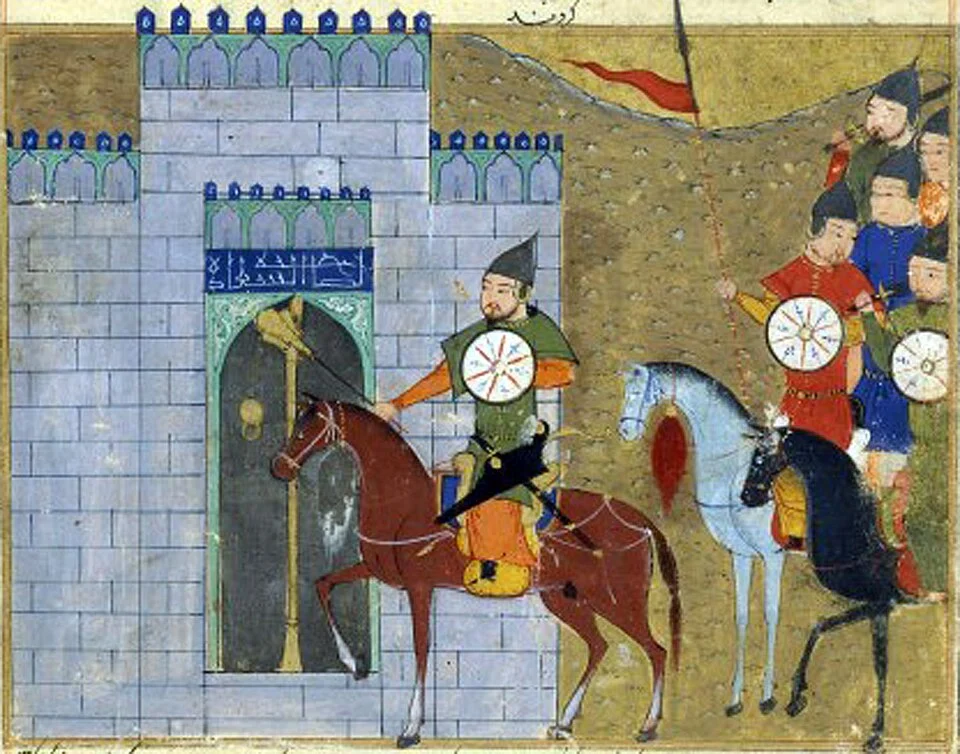
Later manuscript illustration of a siege of Beijing, conventionally captioned 1213–14; contextual imagery for the northern Chinese campaigns, not an eyewitness view of the 1215 capture. Sayf al-Vâhidî. Hérât. Afghanistan · Public domain.
In northern China, Mongol forces confront the wealthy Jin dynasty. In 1215 they capture Zhongdu, on the site of present-day Beijing. Siege warfare, hunger and plunder bring catastrophe to the city. This is a major victory, but it is not the conquest of all China. The Jin state survives farther south until 1234, and the Southern Song will resist for decades longer.
Historical dates and route context
A chronological overview of separate campaigns, governments and themes, not one continuous expedition. Year-only milestones use editorial months and days. Territory shading is schematic: dated snapshots are not surveyed front lines. From 1260 it distinguishes selected successor states rather than one centrally governed empire; dashed Rus areas denote tributary relations. Campaigns do not imply lasting possession.
Bukhara and Samarkand · conquest reaches Central Asia
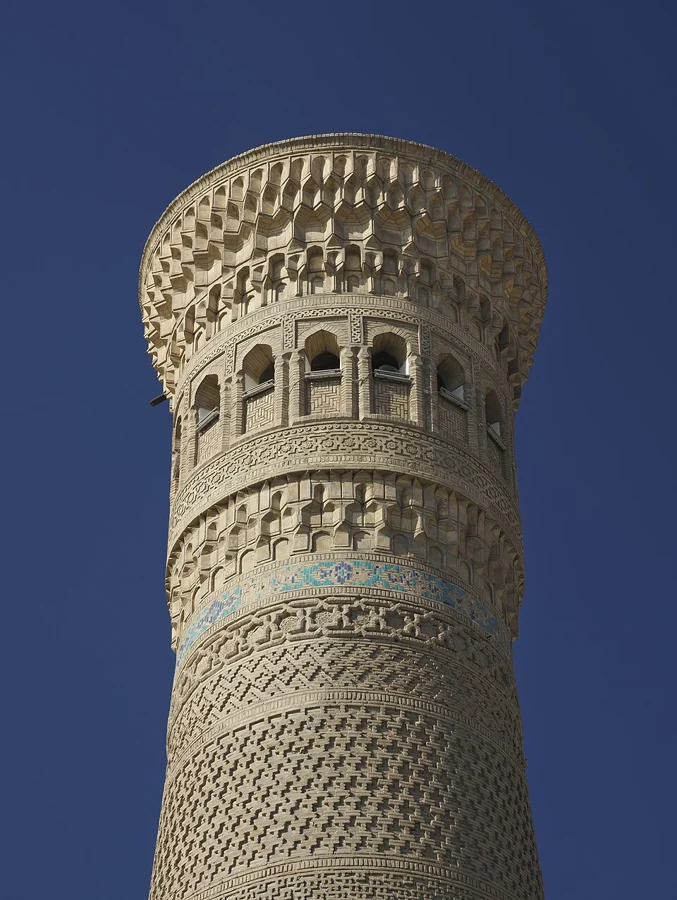
The medieval Kalyan Minaret in Bukhara, photographed in modern times. Later surrounding buildings should not be read as the cityscape of 1220. Petar Milošević · CC BY-SA 4.0.
The next great campaign strikes the Khwarazmian realm in Central Asia. Bukhara and Samarkand fall in 1220. These are established centres of learning, religion and commerce, not empty spaces awaiting an empire. Conquest brings killing, displacement and forced movement of skilled workers. Medieval accounts describe immense losses, but their spectacular casualty totals cannot be treated as reliable counts. Survivors face the long work of rebuilding.
Historical dates and route context
A chronological overview of separate campaigns, governments and themes, not one continuous expedition. Year-only milestones use editorial months and days. Territory shading is schematic: dated snapshots are not surveyed front lines. From 1260 it distinguishes selected successor states rather than one centrally governed empire; dashed Rus areas denote tributary relations. Campaigns do not imply lasting possession. Keep past is limited to this scene because the existing Bukhara and Samarkand battle records have year-only dates stored in January.
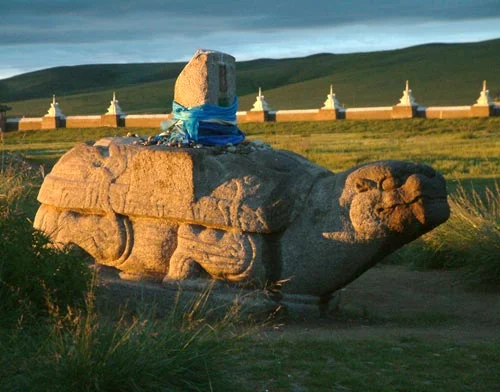
A surviving stone turtle at Karakorum, photographed in modern times; archaeological context rather than a reconstruction of the complete capital. Frithjof Spangenberg · CC BY-SA 2.5.
Chinggis Khan dies in 1227, but expansion continues under his successors. His son Ogedei develops Karakorum as an imperial capital in the Orkhon valley. By 1235, building a permanent centre is part of the challenge of ruling distant territories. Envoys, officials, merchants and craftsmen bring different languages and beliefs into the city. The empire still depends on pastoral life, while increasingly drawing its resources from towns and farmland.
Historical dates and route context
A chronological overview of separate campaigns, governments and themes, not one continuous expedition. Year-only milestones use editorial months and days. Territory shading is schematic: dated snapshots are not surveyed front lines. From 1260 it distinguishes selected successor states rather than one centrally governed empire; dashed Rus areas denote tributary relations. Campaigns do not imply lasting possession.
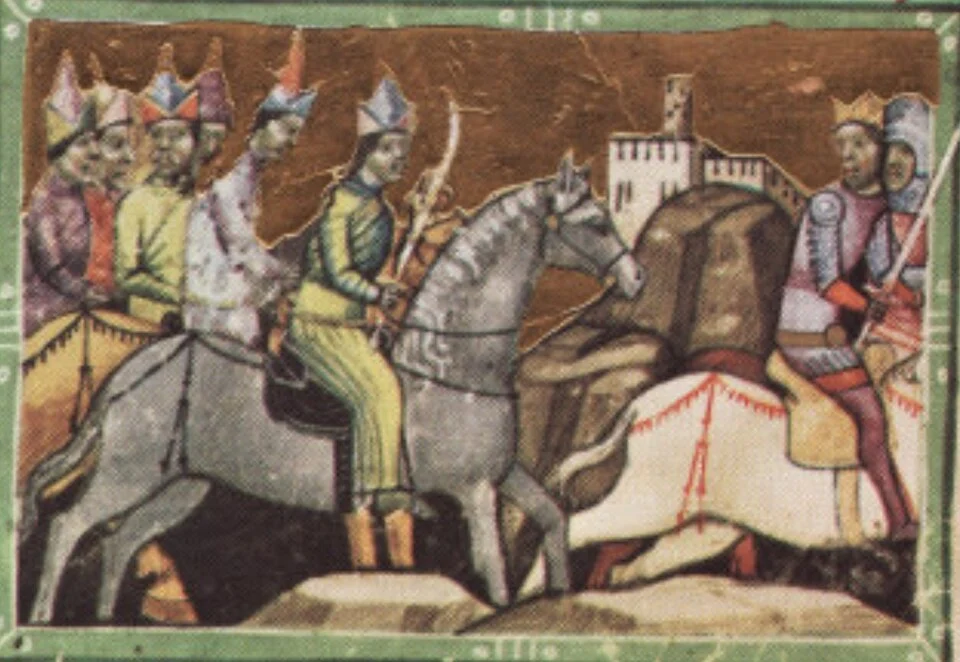
Fourteenth-century Chronicon Pictum illustration associated with the Mongol invasion of Hungary; a later medieval representation, not an eyewitness battle image. Márk Kálti · Public domain.
In 1241, Mongol armies carry war into Poland and Hungary. At Mohi, near the Sajo River, they defeat the army of King Bela the Fourth. Communities across the invaded regions suffer destruction and flight. The armies withdraw from Hungary in 1242; their victory does not turn the whole country into a lasting Mongol province. Farther east, many Rus principalities will face demands for tribute under Mongol overlordship.
Historical dates and route context
A chronological overview of separate campaigns, governments and themes, not one continuous expedition. Year-only milestones use editorial months and days. Territory shading is schematic: dated snapshots are not surveyed front lines. From 1260 it distinguishes selected successor states rather than one centrally governed empire; dashed Rus areas denote tributary relations. Campaigns do not imply lasting possession. The Hungarian campaign is represented by battle and war markers, never by lasting Mongol territory over Hungary.
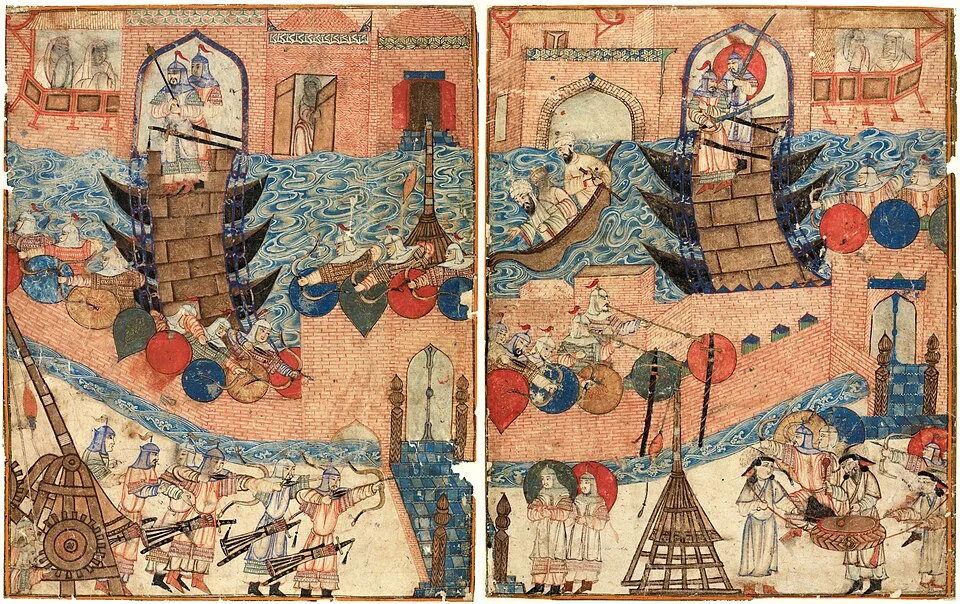
Historical manuscript illustration of the fall of Baghdad in the Diez Albums; a later representation of the 1258 siege. 14th century artist · Public domain.
In 1258, Hulegu, a grandson of Chinggis Khan, captures Baghdad. The Abbasid caliph is killed, ending his dynasty’s rule in the city. Baghdad has been a great centre of government, scholarship and religious life; its inhabitants now endure a devastating sack. Mongol power in Iran and Iraq will develop into the Ilkhanate. Its rulers later adopt local traditions, but that cultural transformation cannot erase the violence of conquest.
Historical dates and route context
A chronological overview of separate campaigns, governments and themes, not one continuous expedition. Year-only milestones use editorial months and days. Territory shading is schematic: dated snapshots are not surveyed front lines. From 1260 it distinguishes selected successor states rather than one centrally governed empire; dashed Rus areas denote tributary relations. Campaigns do not imply lasting possession.
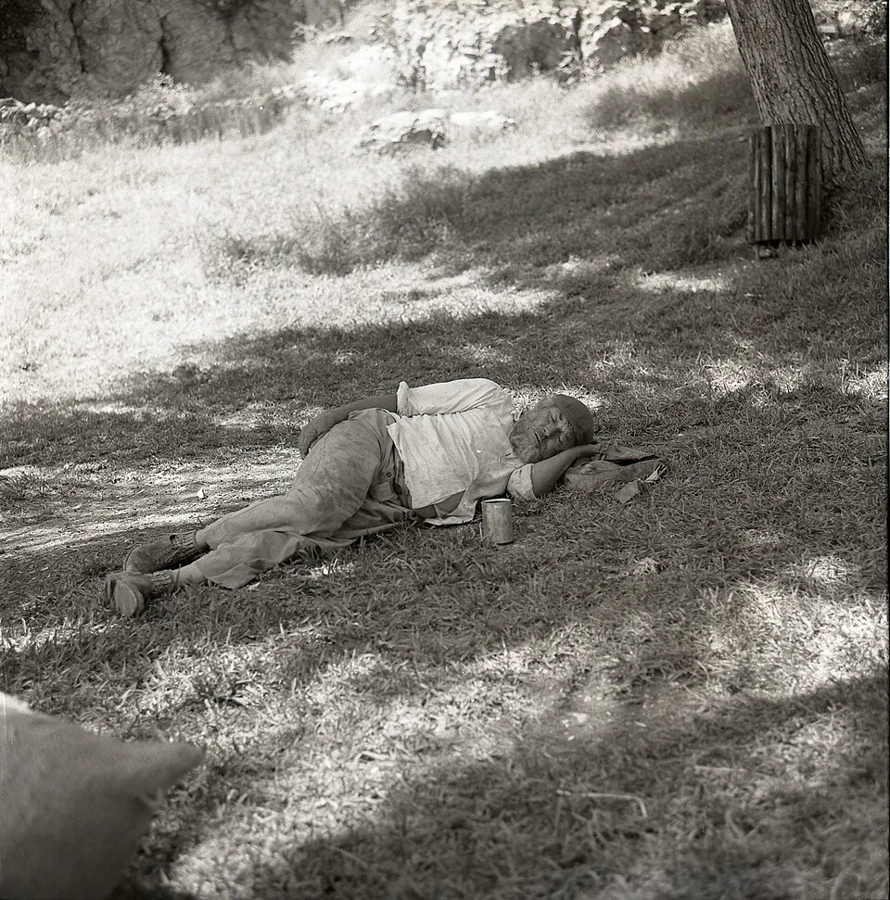
The Harod spring area, photographed in 1962; landscape context for Ain Jalut in the Jezreel valley, not a reconstruction of the battle. Boris Carmi · CC BY 4.0.
At Ain Jalut in 1260, a Mamluk army defeats the Mongol force remaining in the region after Hulegu has withdrawn with much of his army. The victory protects Egypt and checks this advance into the eastern Mediterranean. Mongol armies will fight here again. One battle does not end their power, and it does not cause the separate succession struggle already breaking the imperial family apart.
Historical dates and route context
A chronological overview of separate campaigns, governments and themes, not one continuous expedition. Year-only milestones use editorial months and days. Territory shading is schematic: dated snapshots are not surveyed front lines. From 1260 it distinguishes selected successor states rather than one centrally governed empire; dashed Rus areas denote tributary relations. Campaigns do not imply lasting possession.
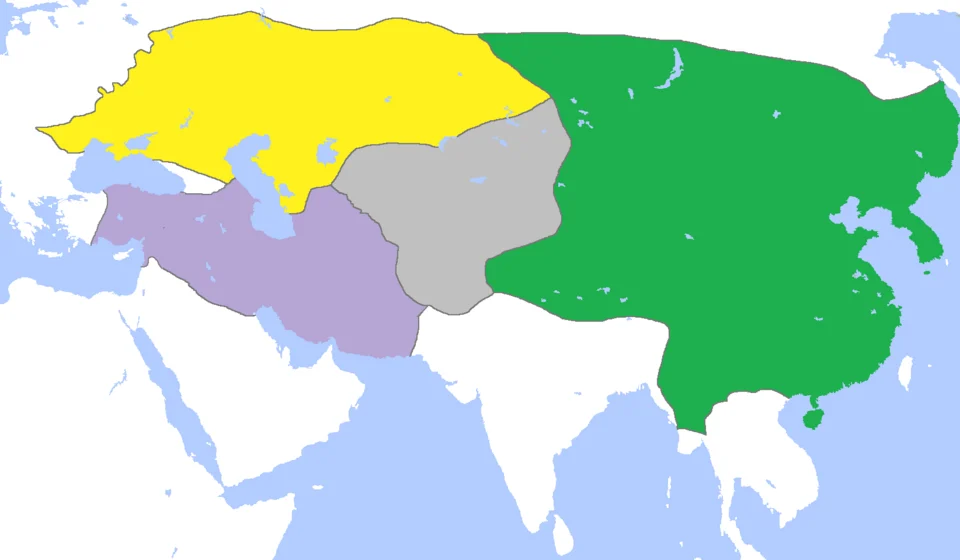
Modern historical map of the principal Mongol khanates around 1300. Later context for the division discussed here, not exact boundaries in 1264. Gabagool · CC BY 3.0.
After the death of Great Khan Mongke, his brothers Kublai and Ariq Boke fight for supremacy. Kublai prevails in 1264, but victory does not restore a single effective government across Eurasia. The Golden Horde, the Chagatai realm, the Ilkhanate and Kublai’s eastern dominions follow increasingly separate paths. Their rulers share family connections and sometimes cooperate, yet they also wage war against one another.
Historical dates and route context
A chronological overview of separate campaigns, governments and themes, not one continuous expedition. Year-only milestones use editorial months and days. Territory shading is schematic: dated snapshots are not surveyed front lines. From 1260 it distinguishes selected successor states rather than one centrally governed empire; dashed Rus areas denote tributary relations. Campaigns do not imply lasting possession. The illustration is a modern map for around 1300, whereas the interactive map shows the selected 1264 snapshot.
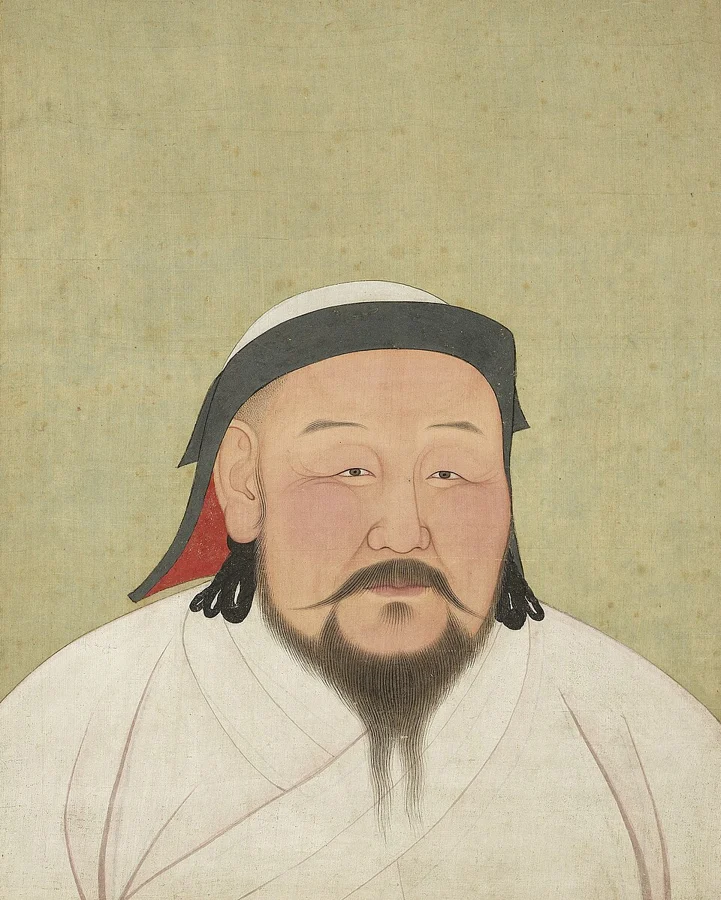
Yuan-dynasty portrait of Kublai Khan; historical court imagery, not an eyewitness view of the final Southern Song battle. Araniko · Public domain.
Kublai has proclaimed the Yuan dynasty in 1271. In 1279, the defeat of the Southern Song completes the conquest of China. His capital at Dadu, today Beijing, and his summer capital at Shangdu express a court drawing on both Chinese institutions and Mongolian traditions. This is one powerful branch of Mongol rule, not a reunited empire. Governing such a large population requires officials, supplies and taxes as well as soldiers.
Historical dates and route context
A chronological overview of separate campaigns, governments and themes, not one continuous expedition. Year-only milestones use editorial months and days. Territory shading is schematic: dated snapshots are not surveyed front lines. From 1260 it distinguishes selected successor states rather than one centrally governed empire; dashed Rus areas denote tributary relations. Campaigns do not imply lasting possession.
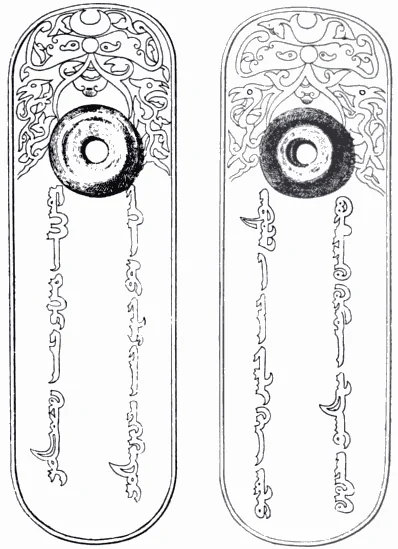
Historical drawing of a Golden Horde paiza, or official pass. The object illustrates authorisation for travel; it does not prove one particular journey. Unknown authorUnknown author · Public domain.
Across Mongol-ruled lands, relay stations and official passes help authorised travellers obtain transport and supplies. Merchants, envoys and skilled workers carry goods and knowledge between distant societies. Dadu and Tabriz belong to this wider world of connections. Journeys can still be dangerous: rival khans, local conflict and compulsory demands on communities complicate the idea of a universal Mongol peace. Exchange grows alongside inequality and coercion.
Historical dates and route context
A chronological overview of separate campaigns, governments and themes, not one continuous expedition. Year-only milestones use editorial months and days. Territory shading is schematic: dated snapshots are not surveyed front lines. From 1260 it distinguishes selected successor states rather than one centrally governed empire; dashed Rus areas denote tributary relations. Campaigns do not imply lasting possession.
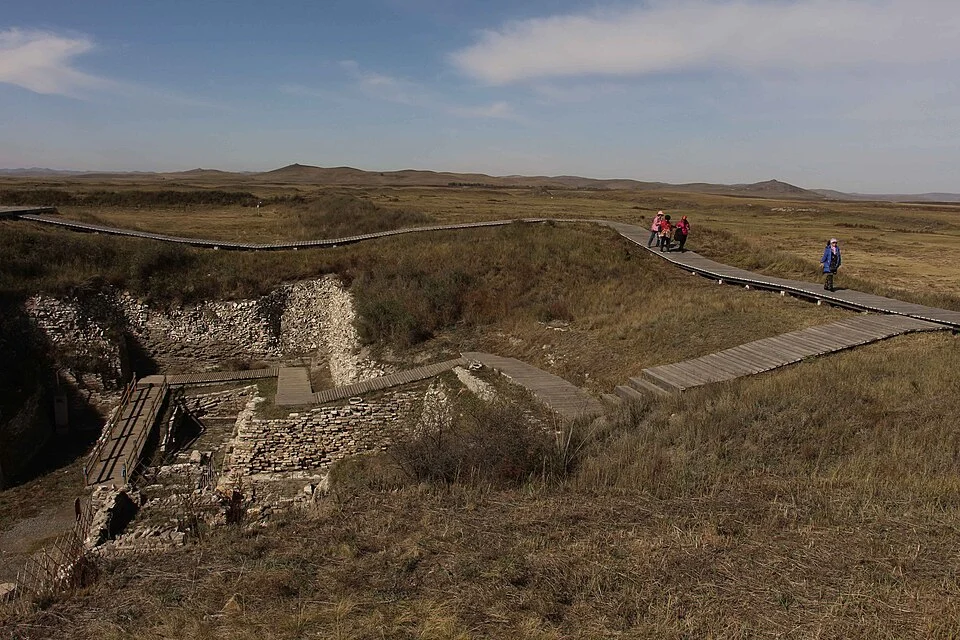
The archaeological site of Shangdu / Xanadu, photographed in modern times. The visible remains do not reconstruct the city in 1368. Flaumfeder · CC BY-SA 4.0.
By 1368, rebellion and the rise of the Ming drive the Yuan court out of Dadu and back towards Mongolia. Shangdu, once a great summer capital, belongs to a changing political landscape. Other Mongol successor states have their own histories of division and survival. The loss of China does not mean the disappearance of Mongolian people or culture. The empire’s legacy remains in altered states, remembered destruction and connections that reshaped Eurasia.
Historical dates and route context
A chronological overview of separate campaigns, governments and themes, not one continuous expedition. Year-only milestones use editorial months and days. Territory shading is schematic: dated snapshots are not surveyed front lines. From 1260 it distinguishes selected successor states rather than one centrally governed empire; dashed Rus areas denote tributary relations. Campaigns do not imply lasting possession.