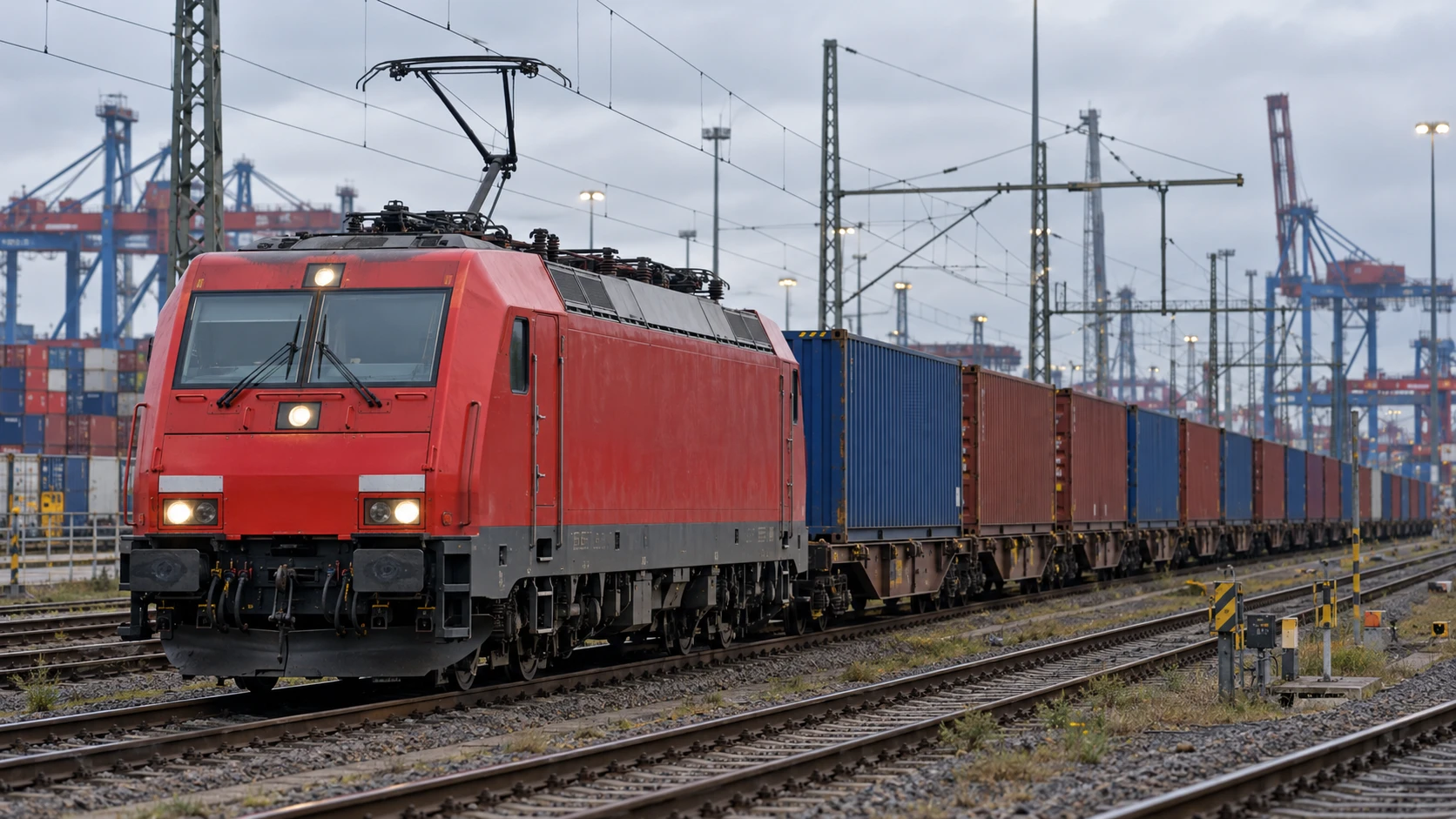
AI-generated historical reconstruction · Representative September 2014 freight departure; not a photograph of the inaugural train.
In September 2014, a container train leaves Hamburg for Zhengzhou, an inland transport centre in China. Organised by DB Schenker and its Chinese partners, the new eastbound service carries manufactured goods across Europe and Asia. It promises a journey of roughly seventeen days: faster than a sea voyage, while offering an alternative to expensive air freight. This is one milestone in a growing railway network, not the first train ever to connect Europe and China. We begin at Hamburg’s Billwerder terminal.
Historical dates and route context
Departure: 1 September 2014. The reported 10,214 km and around 17 days are the launch plan, not a verified arrival log. Intermediate dates, hours and positions, including the estimated 18 September endpoint, are editorial timing. Sources verify the six-country chain, not this train’s complete junction list. Geometry illustrates a conventional corridor via Brest and Dostyk–Alashankou; those junctions are contextual reconstructions, not verified calls of this inaugural train. Regional anchors do not claim station stops. Modern country outlines are used.
Industrial robots in storage, 2005 · Lothar Truemper (Asco) · CC BY 2.0 · Illustrates the cargo category, not the actual machines shipped in 2014. Unaltered external photograph.
At Hamburg’s Billwerder terminal, the departure signal is given on 1 September 2014. 41 containers are starting an eastbound journey to Zhengzhou. Among their cargo are industrial robots for a technology company. The service accepts shipments from different customers, combining them into one long-distance train. As the containers head across Germany and into Poland, the attraction is time: goods can travel overland between European producers and Chinese factories without making the much longer sea journey.
Historical dates and route context
Departure: 1 September 2014. The reported 10,214 km and around 17 days are the launch plan, not a verified arrival log. Intermediate dates, hours and positions, including the estimated 18 September endpoint, are editorial timing. Sources verify the six-country chain, not this train’s complete junction list. Geometry illustrates a conventional corridor via Brest and Dostyk–Alashankou; those junctions are contextual reconstructions, not verified calls of this inaugural train. Regional anchors do not claim station stops. Modern country outlines are used.
The Polish–Belarusian frontier · the cargo changes trains
Brest North freight yard, May 2014 · Context view, not the Hamburg inaugural train · Dima Sugonyaev · CC BY-SA 3.0 · Unaltered external photograph.
Ahead lies the Polish–Belarusian frontier, one of the great interfaces in Eurasian rail transport. Around Brest, rails of two different widths meet: 1,435 millimetres in Poland and 1,520 millimetres to the east. Containers can be lifted onto another set of wagons while the goods remain sealed inside. A direct freight service therefore does not mean one locomotive and the same wagons crossing the entire continent. The containers provide the continuity.
Historical dates and route context
Departure: 1 September 2014. The reported 10,214 km and around 17 days are the launch plan, not a verified arrival log. Intermediate dates, hours and positions, including the estimated 18 September endpoint, are editorial timing. Sources verify the six-country chain, not this train’s complete junction list. Geometry illustrates a conventional corridor via Brest and Dostyk–Alashankou; those junctions are contextual reconstructions, not verified calls of this inaugural train. Regional anchors do not claim station stops. Modern country outlines are used.
Yudino, Russia, February 2018 · Later railway illustration; neither a verified stop nor the locomotive of this 2014 service · Dmitriy M · CC BY-SA 3.0 · Unaltered external photograph.
The journey continues through Belarus and into Russia. Beyond the border terminals, thousands of kilometres of established railway make the new service possible. Locomotives, crews and operating organisations change along the way. Each handover must fit into the next: a container waiting in a yard still costs its owner time. The achievement is coordination across railway systems, rather than the invention of a new track stretching all the way from Germany to China.
Historical dates and route context
Departure: 1 September 2014. The reported 10,214 km and around 17 days are the launch plan, not a verified arrival log. Intermediate dates, hours and positions, including the estimated 18 September endpoint, are editorial timing. Sources verify the six-country chain, not this train’s complete junction list. Geometry illustrates a conventional corridor via Brest and Dostyk–Alashankou; those junctions are contextual reconstructions, not verified calls of this inaugural train. Regional anchors do not claim station stops. Modern country outlines are used.
Kazakhstan industrial railway, 2011 · motowoz / Trainpix · CC0 · Representative railway context, not the international freight train or its verified route. Unaltered external photograph.
Across Kazakhstan, the railway joins Russia’s network to the frontier of western China. Vast distances make this part of the journey a test of reliable connections. Container rail offers a middle choice between slow ocean shipping and costly air transport, particularly for manufactured goods whose delivery dates matter. For the companies waiting for these machines and components, the value of the journey lies in turning a continental distance into a dependable transport schedule.
Historical dates and route context
Departure: 1 September 2014. The reported 10,214 km and around 17 days are the launch plan, not a verified arrival log. Intermediate dates, hours and positions, including the estimated 18 September endpoint, are editorial timing. Sources verify the six-country chain, not this train’s complete junction list. Geometry illustrates a conventional corridor via Brest and Dostyk–Alashankou; those junctions are contextual reconstructions, not verified calls of this inaugural train. Regional anchors do not claim station stops. Modern country outlines are used.
Alashankou border station, 2017 · Tatarstan.ru · CC BY 4.0 · Later illustration of the gateway, not the September 2014 train. Unaltered external photograph.
At the Kazakh–Chinese frontier, railway systems of different widths meet again. Dostyk and Alashankou form one established gateway: broad-gauge wagons on the Kazakh side connect with China’s standard-gauge network. Containers are transferred once more. Beyond the frontier, the cargo can continue east across China. The border is an important reminder of what an international train service really involves: cranes, customs, paperwork, railway workers and carefully connected departures.
Historical dates and route context
Departure: 1 September 2014. The reported 10,214 km and around 17 days are the launch plan, not a verified arrival log. Intermediate dates, hours and positions, including the estimated 18 September endpoint, are editorial timing. Sources verify the six-country chain, not this train’s complete junction list. Geometry illustrates a conventional corridor via Brest and Dostyk–Alashankou; those junctions are contextual reconstructions, not verified calls of this inaugural train. Regional anchors do not claim station stops. Modern country outlines are used.
Zhengzhou Railway Container Terminal, June 2020 · Later illustration of the destination’s freight network, not the 2014 arrival · Windmemories · CC BY-SA 4.0 · Unaltered external photograph.
Beyond western China, the journey continues towards Zhengzhou in Henan province. The destination is inland, rather than a seaport: railways connect it directly with distant suppliers and markets. The launch plan allows around seventeen days for the entire 10,214-kilometre journey from Hamburg. As the containers approach their destination, the promised advantage is clear: a faster overland link between European industry and central China.
Historical dates and route context
Departure: 1 September 2014. The reported 10,214 km and around 17 days are the launch plan, not a verified arrival log. Intermediate dates, hours and positions, including the estimated 18 September endpoint, are editorial timing. Sources verify the six-country chain, not this train’s complete junction list. Geometry illustrates a conventional corridor via Brest and Dostyk–Alashankou; those junctions are contextual reconstructions, not verified calls of this inaugural train. Regional anchors do not claim station stops. Modern country outlines are used.
Container train near Hamburg harbour, March 2019 · Virtual-Pano · CC BY 4.0 · Later context image, not the inaugural 2014 departure. Unaltered external photograph.
Hamburg and Zhengzhou already have a westbound connection. DB Schenker has offered regular weekly freight trains between China and Germany since 2011. This departure adds an eastbound service to an expanding system. Its significance is practical: it helps turn an occasional cross-continental journey into a transport option that businesses can plan around. The story ends with containers reaching an inland Chinese hub, but the larger change is a growing web of rail connections linking factories, cities and customers across Eurasia.
Historical dates and route context
Departure: 1 September 2014. The reported 10,214 km and around 17 days are the launch plan, not a verified arrival log. Intermediate dates, hours and positions, including the estimated 18 September endpoint, are editorial timing. Sources verify the six-country chain, not this train’s complete junction list. Geometry illustrates a conventional corridor via Brest and Dostyk–Alashankou; those junctions are contextual reconstructions, not verified calls of this inaugural train. Regional anchors do not claim station stops. Modern country outlines are used.